Münster to Munich is 318 miles (511 km), a flight of about 1 hour 5 minutes.
The Alpine panorama on final approach into Munich from the left side is one of the most spectacular views available on any short domestic German route. While the right side offers decent views on takeoff from FMO, the left side also captures the Bavarian lakes and the Alps during descent, making it the stronger choice for the full flight.
Flight Path
The flight tracks southeast over the North German Plain transitioning to the Bavarian Plateau. Roughly midway, the aircraft passes over the Swabian highlands around Augsburg. The Danube valley may be faintly visible as a broad flat corridor. As the flight progresses south, the terrain gradually rises from flat lowlands to the rolling Bavarian Plateau before the Alps appear on the southern horizon during descent.
Great circle distance and headings ›Phase by phase
Takeoff from FMO
RIGHTFMO's primary runway is oriented roughly east-west (Runway 07/25). Departing eastbound toward Munich, the aircraft typically climbs and turns southeast. The right side faces south, giving views over the Teutoburg Forest ridge and the flat Westphalian lowlands stretching toward Bielefeld.
Landing at MUC
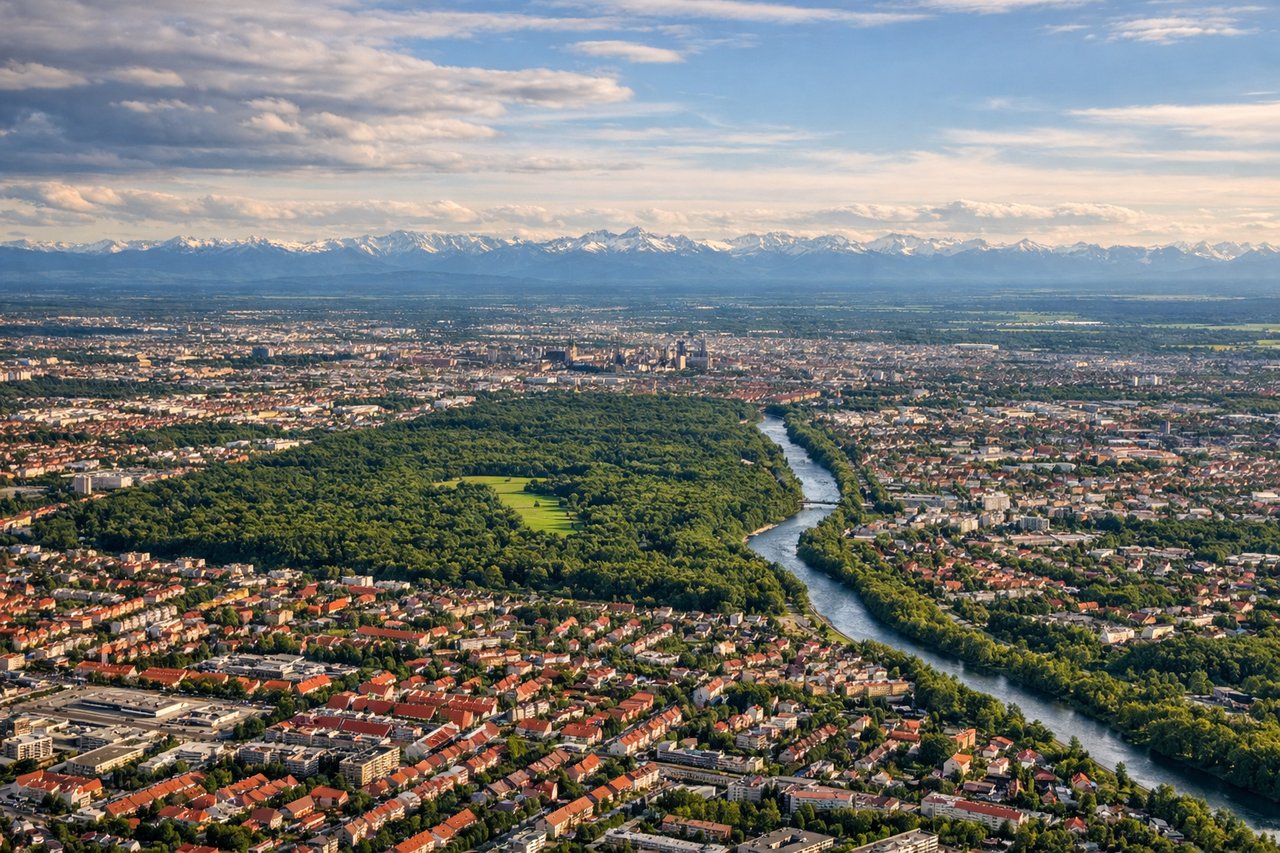
LEFTMUC's primary arrival from the northwest typically uses Runway 26L/26R, meaning the aircraft approaches from the northeast and lands heading west. On left side seats, passengers get a clear view south toward the Bavarian Alps — the full arc of the Alps from the Zugspitze massif westward is visible on approach. The right side faces north over flat Bavarian farmland with little of interest.
Landmarks on this routeAll landmarks →
Will your flight be in sunlight?
Pick a date and time in the Sun Map to watch the sun move across your whole flight.
About This Route
Which side of the plane should I sit on flying from Munster Osnabruck (FMO) to Munich (MUC)?
Sit on the Left side of the plane for the best views on flights from Münster to Munich. The Alpine panorama on final approach into Munich from the left side is one of the most spectacular views available on any short domestic German route. While the right side offers decent views on takeoff from FMO, the left side also captures the Bavarian lakes and the Alps during descent, making it the stronger choice for the full flight.
What can I see during takeoff from Munster Osnabruck in Münster?
During takeoff from Munster Osnabruck (FMO), sit on the Right side for the best views. FMO's primary runway is oriented roughly east-west (Runway 07/25). Departing eastbound toward Munich, the aircraft typically climbs and turns southeast. The right side faces south, giving views over the Teutoburg Forest ridge and the flat Westphalian lowlands stretching toward Bielefeld. Notable sights include: Teutoburg Forest ridge (Teutoburger Wald), Osnabrück city center to the northwest, Münster city and its cathedral visible to the southwest, flat Westphalian agricultural plain.
What can I see when landing at Munich in Munich?
When landing at Munich (MUC), sit on the Left side for the best views. MUC's primary arrival from the northwest typically uses Runway 26L/26R, meaning the aircraft approaches from the northeast and lands heading west. On left side seats, passengers get a clear view south toward the Bavarian Alps — the full arc of the Alps from the Zugspitze massif westward is visible on approach. The right side faces north over flat Bavarian farmland with little of interest. Notable sights include: Bavarian Alps including Zugspitze massif, Ammersee lake, Starnberger See lake, Munich city center and the English Garden.
How long is the flight from Münster to Munich?
The flight from Munster Osnabruck (FMO) to Munich (MUC) takes about 1 hour 5 minutes. The shortest flight path between them is 318 miles (511 km); winds and air traffic control usually add a few percent.
What does the Münster to Munich flight path pass over?
The flight tracks southeast over the North German Plain transitioning to the Bavarian Plateau. Roughly midway, the aircraft passes over the Swabian highlands around Augsburg. The Danube valley may be faintly visible as a broad flat corridor. As the flight progresses south, the terrain gradually rises from flat lowlands to the rolling Bavarian Plateau before the Alps appear on the southern horizon during descent.