Left seats capture the more dramatic geography: Crete's northern coastline and Aegean islands on departure, then the Alpine foothills and major river valleys (Danube, Main, Rhine) during cruise over central Europe. Right seats see primarily inland terrain and industrial zones.
Flight Path
The flight path crosses the Aegean Sea northwestward, then over mainland Greece (Thessaly plain), into the Balkans. Notable features include: the Pindus Mountains (running north-south through Greece, visible as a ridge line), the Danube River valley (forming the Greece-Bulgaria/Serbia border), the Hungarian Plain (flat, extensive), the Main River valley in Germany, and finally the Rhine valley approaching Düsseldorf. The Alps are typically south of the direct routing but visible on the horizon from cruise altitude if flying slightly north of the great circle track.
Great circle distance and headings ›
.jpg?width=600)


Phase by phase
Takeoff from HER
LEFTHeraklion typically departs eastbound (runways 09/27, with eastbound preference). Left seats face north toward the Cretan coastline and the Aegean Sea, offering immediate views of the northern shore and islands. Right seats face south toward the White Mountains interior.
Landing at DUS
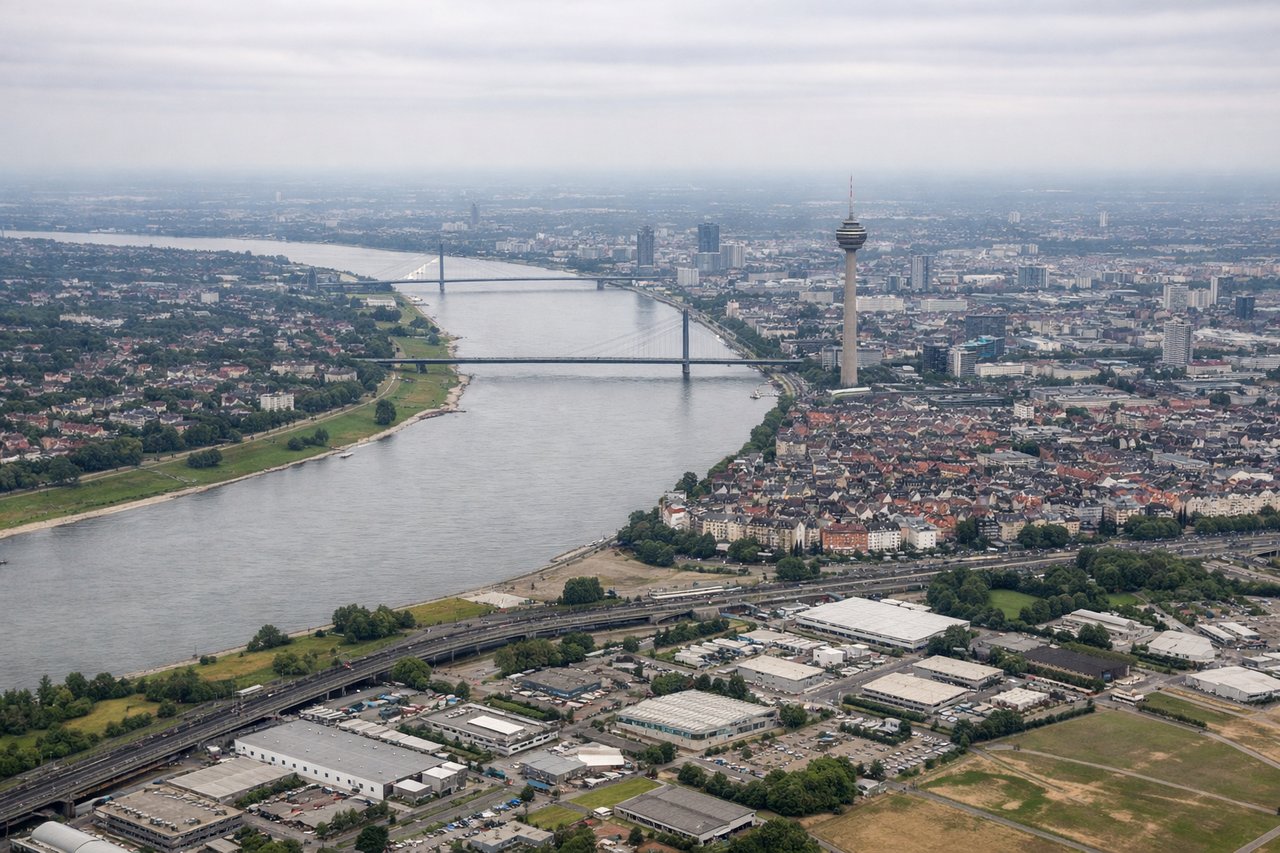
RIGHTApproaching Düsseldorf from the southeast (typical arrival routing), aircraft descend on westbound vectors. Right seats face north toward the Rhine River valley and the industrial Ruhr region. Left seats face south toward the Bergisches Land hills. The Rhine's course and the city's position on its banks are more prominent from the right.
Landmarks on this routeAll landmarks →
Will your flight be in sunlight?
See exactly which side of the plane gets sun and shade at your departure time.
About This Route
Which side of the plane should I sit on flying from Nikos Kazantzakis (HER) to Dusseldorf (DUS)?
Sit on the Left side of the plane for the best views on flights from Heraklion to Duesseldorf. Left seats capture the more dramatic geography: Crete's northern coastline and Aegean islands on departure, then the Alpine foothills and major river valleys (Danube, Main, Rhine) during cruise over central Europe. Right seats see primarily inland terrain and industrial zones.
What can I see during takeoff from Nikos Kazantzakis in Heraklion?
During takeoff from Nikos Kazantzakis (HER), sit on the Left side for the best views. Heraklion typically departs eastbound (runways 09/27, with eastbound preference). Left seats face north toward the Cretan coastline and the Aegean Sea, offering immediate views of the northern shore and islands. Right seats face south toward the White Mountains interior. Notable sights include: Aegean Sea (immediate north), Cretan coastline with Heraklion harbor, Dia Island (small island 6 km north), northern Crete's coastal plain.
What can I see when landing at Dusseldorf in Duesseldorf?
When landing at Dusseldorf (DUS), sit on the Right side for the best views. Approaching Düsseldorf from the southeast (typical arrival routing), aircraft descend on westbound vectors. Right seats face north toward the Rhine River valley and the industrial Ruhr region. Left seats face south toward the Bergisches Land hills. The Rhine's course and the city's position on its banks are more prominent from the right. Notable sights include: Rhine River (main geographic feature), Düsseldorf city center and harbor district, Ruhr industrial zone to the north, Lower Rhine plain extending northward.
How long is the flight from Heraklion to Duesseldorf?
The flight from Nikos Kazantzakis (HER) to Dusseldorf (DUS) takes Approximately 4 hours 15 minutes.
What does the Heraklion to Duesseldorf flight path pass over?
The flight path crosses the Aegean Sea northwestward, then over mainland Greece (Thessaly plain), into the Balkans. Notable features include: the Pindus Mountains (running north-south through Greece, visible as a ridge line), the Danube River valley (forming the Greece-Bulgaria/Serbia border), the Hungarian Plain (flat, extensive), the Main River valley in Germany, and finally the Rhine valley approaching Düsseldorf. The Alps are typically south of the direct routing but visible on the horizon from cruise altitude if flying slightly north of the great circle track.