Right-side seats win overall because the takeoff view of Mexico City and the Sierra de Guadalupe is more visually dramatic and sustained than the landing approach. While the left side offers good Hill Country views on descent, the northeasterly climb-out from MEX provides a longer, more detailed perspective of Mexico's high-altitude geography.
Flown MEX to AUS? Did we get it right?
Flight Path
Mexico City to Austin is 749 miles (1,205 km), a flight of about 2 hours 15 minutes.
The flight path crosses the Sierra Madre Oriental's foothills in northern Mexico (visible as a series of parallel ridges running northwest-southeast around 1.5 hours into flight), then transitions into the Texas plateau. The Rio Grande valley becomes visible roughly 45 minutes before landing, marking the US-Mexico border. The Edwards Plateau's distinctive limestone terrain dominates the final 30 minutes of approach into Austin.
Great circle distance and headings ›

Phase by phase
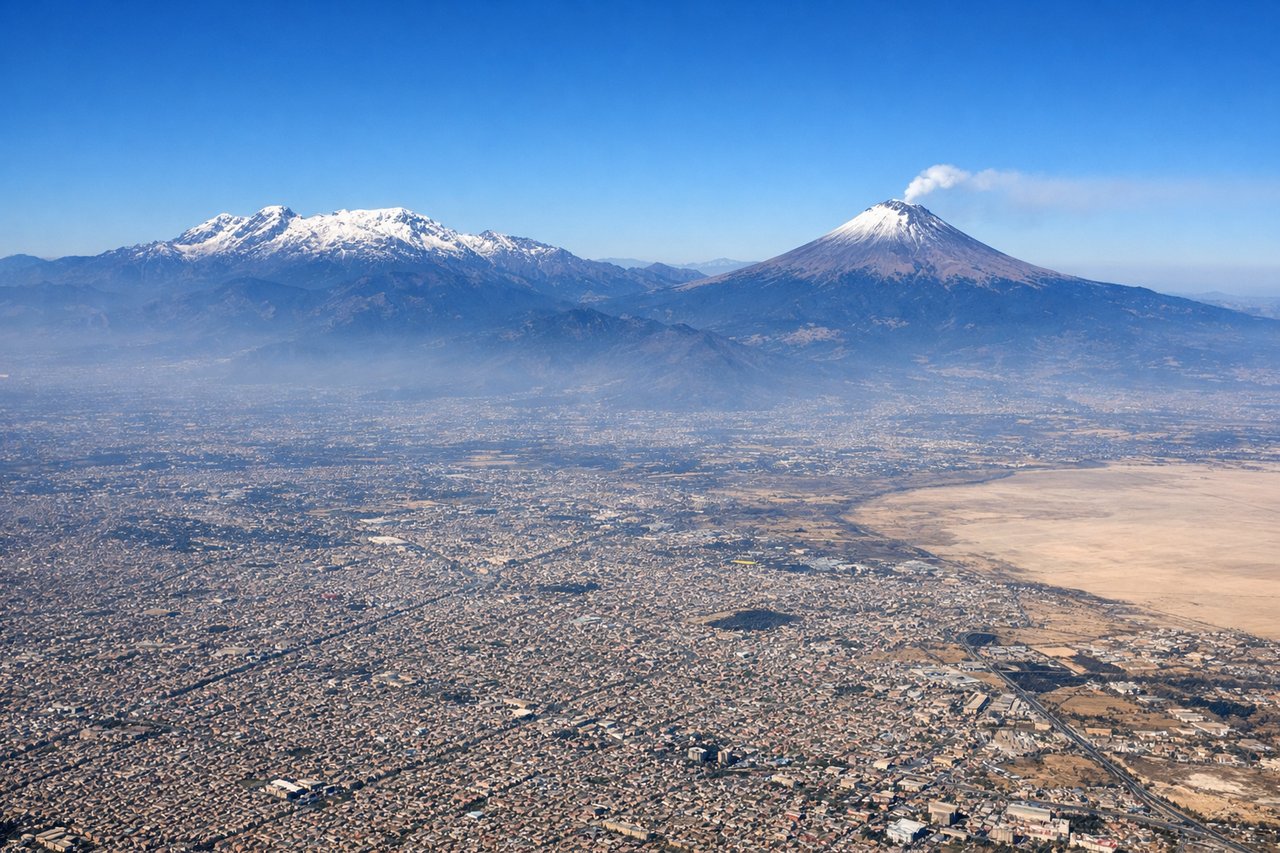
Takeoff from MEX
RIGHTRight-side seats capture the Sierra de Guadalupe and the sprawling Mexico City metropolitan area as you climb northeastward. MEX typically departs runways 05L/05R or 23L/23R; northeasterly departures give the best view of the city's eastern edge and surrounding highlands before turning toward Austin.

Landing at AUS
LEFTLeft-side seats offer views of the Colorado River valley and the Hill Country's limestone terrain as you descend into Austin from the northeast. AUS typically lands runways 17L/17R or 35L/35R; northeast approaches provide excellent sightlines of the Balcones Escarpment and the Edwards Plateau's distinctive topography.
Will your flight be in sunlight?
Pick a date and time in the Sun Map to watch the sun move across your whole flight.
About This Route
Which side of the plane should I sit on flying from Licenciado Benito Juarez International (MEX) to Austin Bergstrom International (AUS)?
Sit on the Right side of the plane for the best views on flights from Mexico City to Austin. Right-side seats win overall because the takeoff view of Mexico City and the Sierra de Guadalupe is more visually dramatic and sustained than the landing approach. While the left side offers good Hill Country views on descent, the northeasterly climb-out from MEX provides a longer, more detailed perspective of Mexico's high-altitude geography.
What can I see during takeoff from Licenciado Benito Juarez International in Mexico City?
During takeoff from Licenciado Benito Juarez International (MEX), sit on the Right side for the best views. Right-side seats capture the Sierra de Guadalupe and the sprawling Mexico City metropolitan area as you climb northeastward. MEX typically departs runways 05L/05R or 23L/23R; northeasterly departures give the best view of the city's eastern edge and surrounding highlands before turning toward Austin. Notable sights include: Sierra de Guadalupe (volcanic ridge northeast of the airport), Lake Texcoco remnants (dried lakebed visible as lighter terrain), Mexico City's northern sprawl extending toward Ecatepec, Teotihuacán pyramids region (distant, ~30 miles north).
What can I see when landing at Austin Bergstrom International in Austin?
When landing at Austin Bergstrom International (AUS), sit on the Left side for the best views. Left-side seats offer views of the Colorado River valley and the Hill Country's limestone terrain as you descend into Austin from the northeast. AUS typically lands runways 17L/17R or 35L/35R; northeast approaches provide excellent sightlines of the Balcones Escarpment and the Edwards Plateau's distinctive topography. Notable sights include: Balcones Escarpment (limestone ridge marking the Hill Country's edge), Colorado River and its reservoirs (Lake Travis, Lake Austin visible as blue water bodies), Hill Country's rolling limestone terrain with cedar and oak coverage, Austin's downtown skyline and Lady Bird Lake (Town Lake).
How long is the flight from Mexico City to Austin?
The flight from Licenciado Benito Juarez International (MEX) to Austin Bergstrom International (AUS) takes about 2 hours 15 minutes. The shortest flight path between them is 749 miles (1,205 km); winds and air traffic control usually add a few percent.
What does the Mexico City to Austin flight path pass over?
The flight path crosses the Sierra Madre Oriental's foothills in northern Mexico (visible as a series of parallel ridges running northwest-southeast around 1.5 hours into flight), then transitions into the Texas plateau. The Rio Grande valley becomes visible roughly 45 minutes before landing, marking the US-Mexico border. The Edwards Plateau's distinctive limestone terrain dominates the final 30 minutes of approach into Austin.