Right-side seats capture the more interesting departure views from RDU (Piedmont terrain and river valley), and while left wins on landing, the departure advantage and the fact that most of the 10-hour Pacific crossing offers little but open ocean make right the better overall choice.
Flight Path
After leaving the Piedmont region, the flight crosses the Appalachian Mountains (visible briefly as ridgelines if departing northeastward), then the Great Plains, Rocky Mountains (if routed through northern corridors), and finally 5+ hours of open Pacific Ocean. The Pacific crossing dominates the flight; no significant landmarks are visible over water except occasional cloud formations and, near Hawaii, the curvature of distant island profiles on approach.
Great circle distance and headings ›.jpeg?width=600)

.jpg?width=600)

.jpeg?width=600)
.jpg?width=600)

Phase by phase
Takeoff from RDU
RIGHTRDU typically departs to the north or northeast. Right-side seats offer views of the Neuse River valley and the urban sprawl of Raleigh-Durham proper as you climb out, with better sightlines to the Piedmont terrain rolling away northward.
Landing at KOA
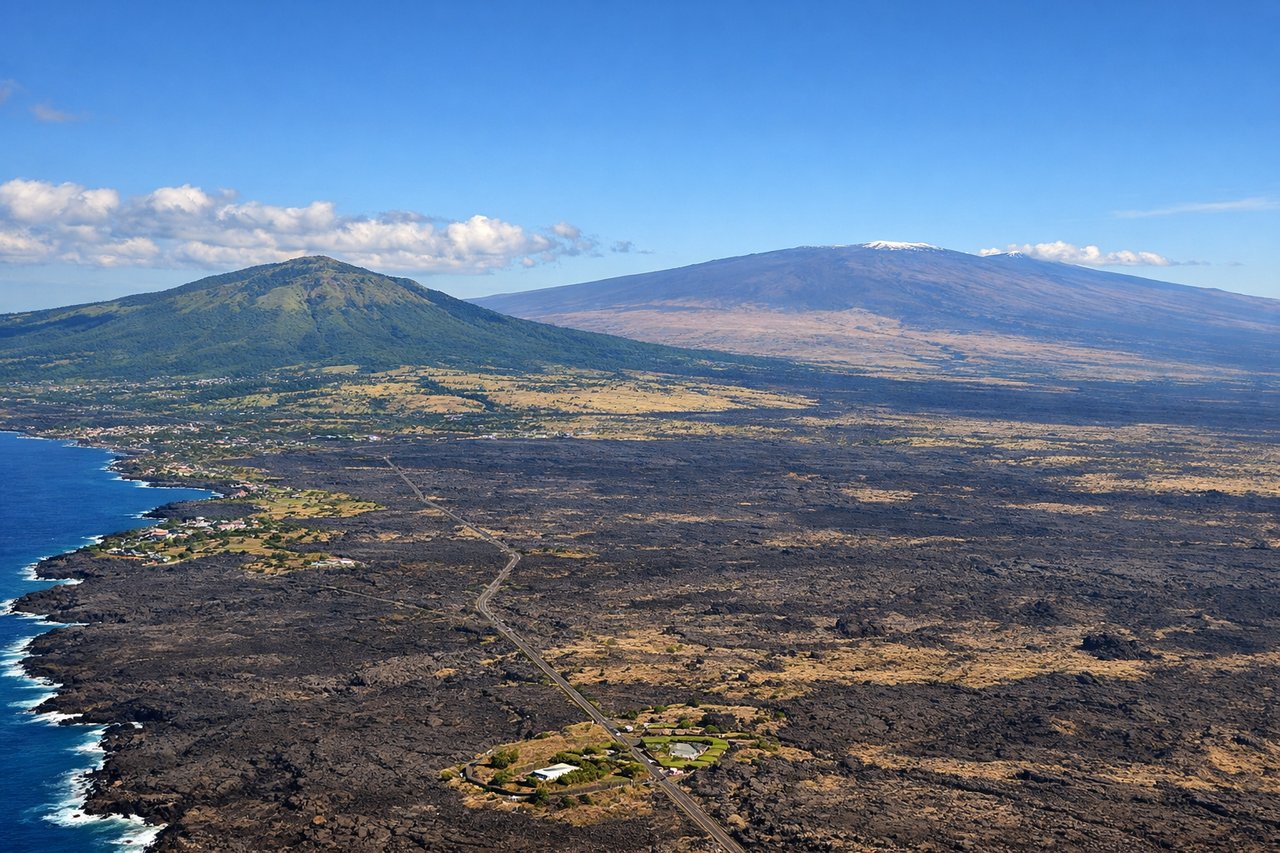
LEFTApproaching Kona on the Big Island typically uses runways aligned roughly north-south. Left-side seats on descent provide excellent views of the Kona coast, the volcanic slopes of Hualalai and Mauna Loa rising inland, and the transition from ocean to lava fields that define this part of Hawaii.
Landmarks on this routeAll landmarks →
Will your flight be in sunlight?
See exactly which side of the plane gets sun and shade at your departure time.
About This Route
Which side of the plane should I sit on flying from Raleigh Durham International (RDU) to Kona International At Keahole (KOA)?
Sit on the Right side of the plane for the best views on flights from Raleigh-Durham to Kona. Right-side seats capture the more interesting departure views from RDU (Piedmont terrain and river valley), and while left wins on landing, the departure advantage and the fact that most of the 10-hour Pacific crossing offers little but open ocean make right the better overall choice.
What can I see during takeoff from Raleigh Durham International in Raleigh-Durham?
During takeoff from Raleigh Durham International (RDU), sit on the Right side for the best views. RDU typically departs to the north or northeast. Right-side seats offer views of the Neuse River valley and the urban sprawl of Raleigh-Durham proper as you climb out, with better sightlines to the Piedmont terrain rolling away northward. Notable sights include: Neuse River (visible as a winding ribbon below), Raleigh downtown skyline (small cluster to the west), Durham urban area (to the northwest), Piedmont plateau rising gradually northward.
What can I see when landing at Kona International At Keahole in Kona?
When landing at Kona International At Keahole (KOA), sit on the Left side for the best views. Approaching Kona on the Big Island typically uses runways aligned roughly north-south. Left-side seats on descent provide excellent views of the Kona coast, the volcanic slopes of Hualalai and Mauna Loa rising inland, and the transition from ocean to lava fields that define this part of Hawaii. Notable sights include: Kona coast and Kailua-Kona town (linear settlement along shore), Hualalai volcano (5,171 ft, dark lava slopes inland), Mauna Loa's massive dome (13,681 ft, visible as a dominant peak further south), Pacific Ocean and reef patterns.
How long is the flight from Raleigh-Durham to Kona?
The flight from Raleigh Durham International (RDU) to Kona International At Keahole (KOA) takes Approximately 10 hours 15 minutes.
What does the Raleigh-Durham to Kona flight path pass over?
After leaving the Piedmont region, the flight crosses the Appalachian Mountains (visible briefly as ridgelines if departing northeastward), then the Great Plains, Rocky Mountains (if routed through northern corridors), and finally 5+ hours of open Pacific Ocean. The Pacific crossing dominates the flight; no significant landmarks are visible over water except occasional cloud formations and, near Hawaii, the curvature of distant island profiles on approach.