Left seats provide superior views during both departure and landing phases. Takeoff offers the Persian Gulf and coastal features, while the cruise segment over the Mediterranean and Europe favors left-side views of major geographic features. Although landing slightly favors right, the extended takeoff and cruise advantages make left the stronger choice overall.
Flown AUH to DUS? Did we get it right?
Flight Path
Abu Dhabi to Duesseldorf is 3,123 miles (5,025 km), a flight of about 7 hours 15 minutes.
The flight path crosses the Persian Gulf, then proceeds northwest over Iraq (avoiding restricted airspace), Syria, Turkey, and the Mediterranean. Notable visible features include: the Taurus Mountains (southern Turkey, bearing 310-320°), the Mediterranean coastline near Cyprus and southern Greece, the Balkans, and the Rhine Valley approaching Düsseldorf. The Zagros Mountains (Iran/Iraq border) may be visible on the left during the initial northwest leg if flying at optimal altitude and clarity. The Alps are typically too far south for this routing but the Carpathians in Romania/Slovakia may appear on the horizon during the European approach phase.
Great circle distance and headings ›

Phase by phase
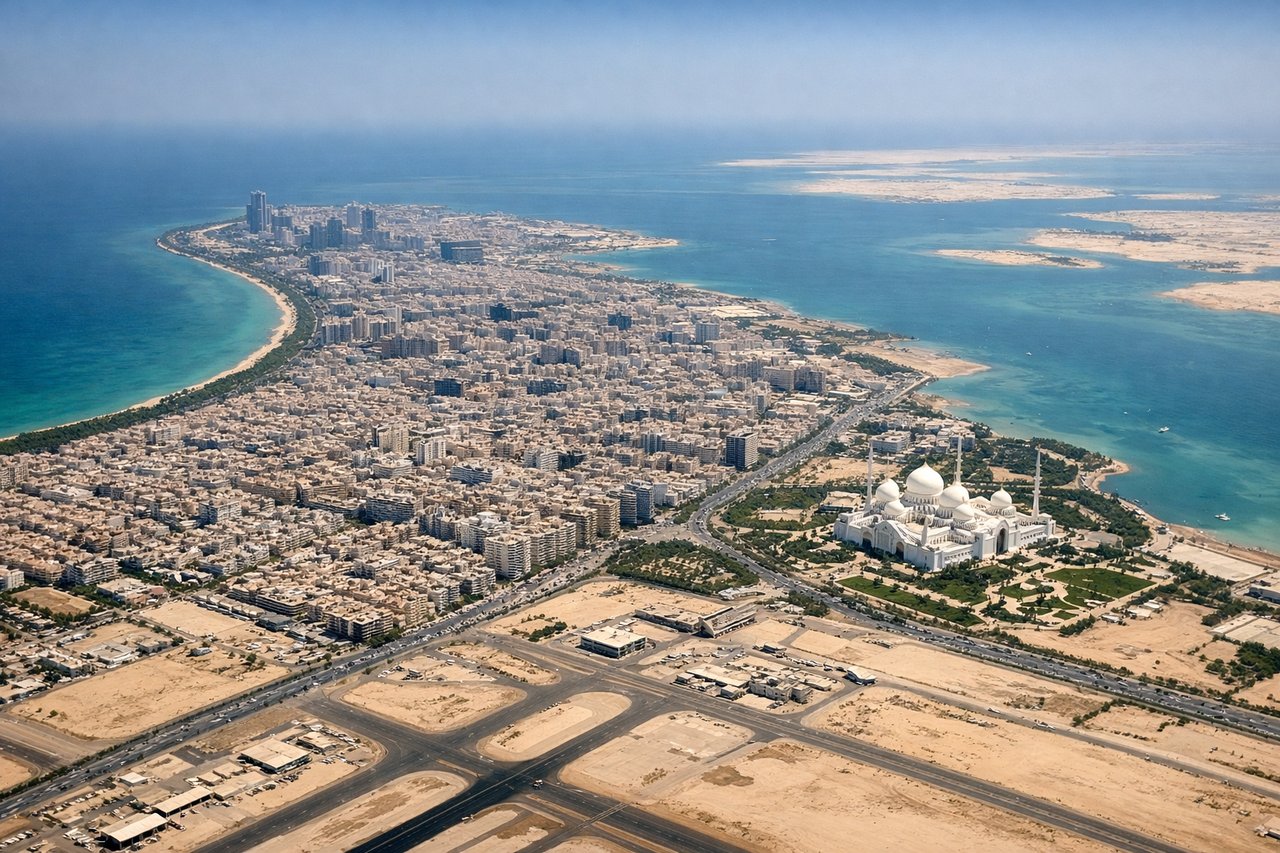
Takeoff from AUH
LEFTAUH typically departs to the northwest on runways 31L/31R. Left seats face toward the Persian Gulf coastline and the initial climb path over water, revealing the shallow gulf bathymetry and coastal features. Right seats face inland toward the desert interior with minimal visual interest.
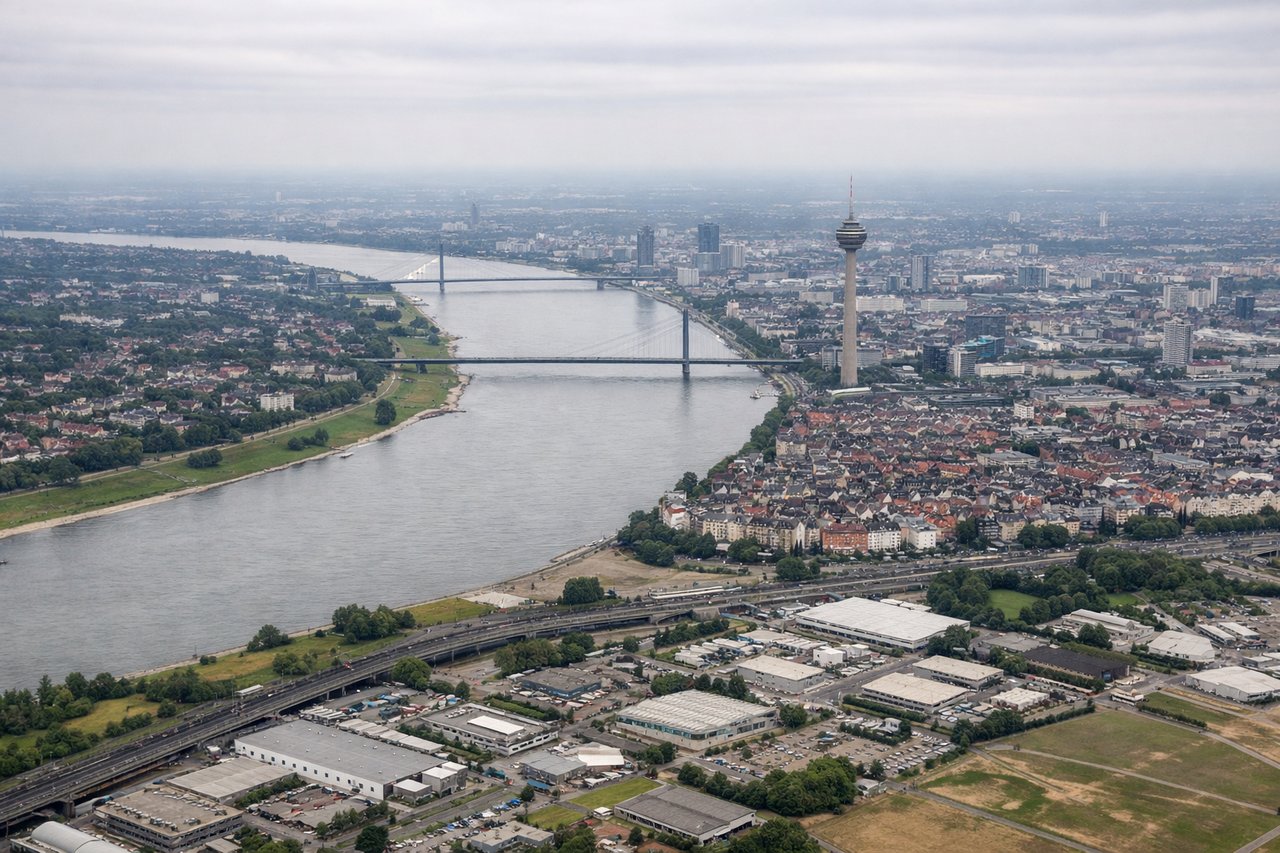
Landing at DUS
RIGHTAUH typically lands on runways 31L/31R from the southeast approach. Right seats face north and northwest during descent, offering views of the Persian Gulf, the Al Ain-Abu Dhabi highway corridor, and the approach path over the coastal plain. Left seats face the interior desert with no distinctive features.
Will your flight be in sunlight?
Pick a date and time in the Sun Map to watch the sun move across your whole flight.
About This Route
Which side of the plane should I sit on flying from Abu Dhabi International (AUH) to Dusseldorf (DUS)?
Sit on the Left side of the plane for the best views on flights from Abu Dhabi to Duesseldorf. Left seats provide superior views during both departure and landing phases. Takeoff offers the Persian Gulf and coastal features, while the cruise segment over the Mediterranean and Europe favors left-side views of major geographic features. Although landing slightly favors right, the extended takeoff and cruise advantages make left the stronger choice overall.
What can I see during takeoff from Abu Dhabi International in Abu Dhabi?
During takeoff from Abu Dhabi International (AUH), sit on the Left side for the best views. AUH typically departs to the northwest on runways 31L/31R. Left seats face toward the Persian Gulf coastline and the initial climb path over water, revealing the shallow gulf bathymetry and coastal features. Right seats face inland toward the desert interior with minimal visual interest. Notable sights include: Persian Gulf (immediate water body), Jebel Ali Port complex (visible as geometric container terminals 25 nm northwest), Mushrif National Park escarpment (distant southern horizon), Abu Dhabi city grid (receding westward).
What can I see when landing at Dusseldorf in Duesseldorf?
When landing at Dusseldorf (DUS), sit on the Right side for the best views. AUH typically lands on runways 31L/31R from the southeast approach. Right seats face north and northwest during descent, offering views of the Persian Gulf, the Al Ain-Abu Dhabi highway corridor, and the approach path over the coastal plain. Left seats face the interior desert with no distinctive features. Notable sights include: Persian Gulf (northern horizon), Al Ain oasis region (distant southeast, 80 nm away), Abu Dhabi city sprawl (expanding below during final approach), Yas Island and Saadiyat Island (visible as developed peninsulas in the gulf, 15-20 nm north).
How long is the flight from Abu Dhabi to Duesseldorf?
The flight from Abu Dhabi International (AUH) to Dusseldorf (DUS) takes about 7 hours 15 minutes. The shortest flight path between them is 3,123 miles (5,025 km); winds and air traffic control usually add a few percent.
What does the Abu Dhabi to Duesseldorf flight path pass over?
The flight path crosses the Persian Gulf, then proceeds northwest over Iraq (avoiding restricted airspace), Syria, Turkey, and the Mediterranean. Notable visible features include: the Taurus Mountains (southern Turkey, bearing 310-320°), the Mediterranean coastline near Cyprus and southern Greece, the Balkans, and the Rhine Valley approaching Düsseldorf. The Zagros Mountains (Iran/Iraq border) may be visible on the left during the initial northwest leg if flying at optimal altitude and clarity. The Alps are typically too far south for this routing but the Carpathians in Romania/Slovakia may appear on the horizon during the European approach phase.