The left side wins mainly on the strength of the long cruise phase: the polar great-circle routing keeps Norway's coast, Greenland's ice cap, and Baffin Island's Arctic terrain visible to the north (left) side for hours, far outclassing the open-ocean views on the right. A strong Mount Rainier view on approach reinforces the left side's advantage, outweighing the right side's edge during takeoff.
Flight Path
Southern Greenland's ice cap and rugged coastal mountains near Davis Strait, with Baffin Island's Arctic tundra visible beyond, marking roughly the highest-latitude point of the route
Great circle distance and headings ›

.jpg?width=600)

Phase by phase

Takeoff from CPH
RIGHTDeparting Kastrup on the typical southbound roll before banking around toward the northwest, the right side gives passengers a clear view of central Copenhagen's skyline and harbor along with the Øresund Bridge stretching toward Sweden. The left side mostly shows flat Zealand farmland fading into Baltic haze.
Landing at SEA
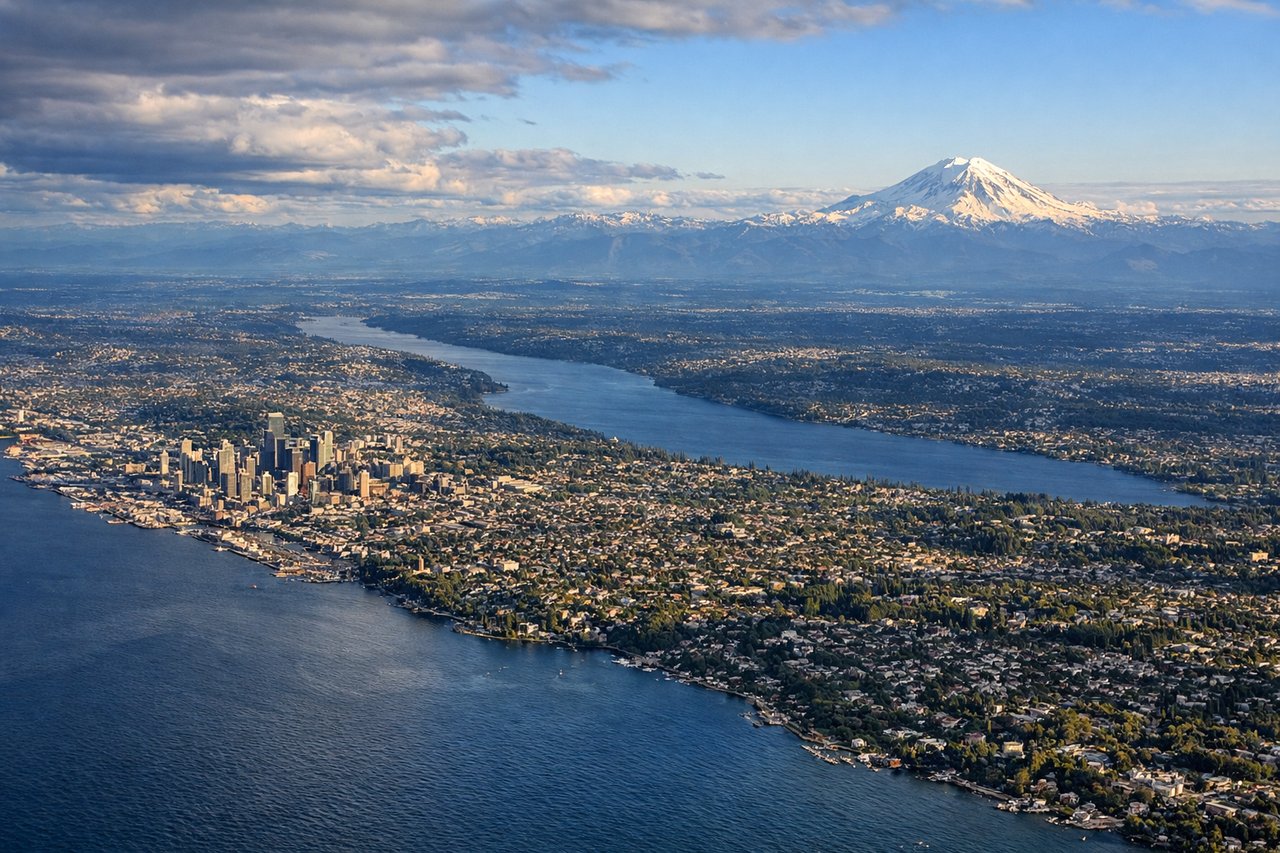
LEFTOn the northbound approach into Sea-Tac, the left side faces east toward the Cascade foothills and the unmistakable snow-capped cone of Mount Rainier rising above the horizon, with Lake Washington's shoreline passing below. The right side shows the Olympic Mountains and Puget Sound, scenic but less dramatic than Rainier's profile.
Landmarks on this routeAll landmarks →
Will your flight be in sunlight?
See exactly which side of the plane gets sun and shade at your departure time.
About This Route
Which side of the plane should I sit on flying from Kastrup (CPH) to Seattle Tacoma International (SEA)?
Sit on the Left side of the plane for the best views on flights from Copenhagen to Seattle. The left side wins mainly on the strength of the long cruise phase: the polar great-circle routing keeps Norway's coast, Greenland's ice cap, and Baffin Island's Arctic terrain visible to the north (left) side for hours, far outclassing the open-ocean views on the right. A strong Mount Rainier view on approach reinforces the left side's advantage, outweighing the right side's edge during takeoff.
What can I see during takeoff from Kastrup in Copenhagen?
During takeoff from Kastrup (CPH), sit on the Right side for the best views. Departing Kastrup on the typical southbound roll before banking around toward the northwest, the right side gives passengers a clear view of central Copenhagen's skyline and harbor along with the Øresund Bridge stretching toward Sweden. The left side mostly shows flat Zealand farmland fading into Baltic haze. Notable sights include: Copenhagen city center and harbor, Øresund Bridge, Malmö skyline (Sweden), Amager island coastline.
What can I see when landing at Seattle Tacoma International in Seattle?
When landing at Seattle Tacoma International (SEA), sit on the Left side for the best views. On the northbound approach into Sea-Tac, the left side faces east toward the Cascade foothills and the unmistakable snow-capped cone of Mount Rainier rising above the horizon, with Lake Washington's shoreline passing below. The right side shows the Olympic Mountains and Puget Sound, scenic but less dramatic than Rainier's profile. Notable sights include: Mount Rainier, Cascade Range foothills, Lake Washington, Seattle's eastern suburbs.
How long is the flight from Copenhagen to Seattle?
The flight from Kastrup (CPH) to Seattle Tacoma International (SEA) takes 9h 45m.
What does the Copenhagen to Seattle flight path pass over?
Southern Greenland's ice cap and rugged coastal mountains near Davis Strait, with Baffin Island's Arctic tundra visible beyond, marking roughly the highest-latitude point of the route