While the takeoff offers excellent Gulf and coastal views on the right, the landing approach on the left provides more sustained scenic interest over Tokyo Bay, the Kanto Plain, and the Boso Peninsula—major geographic features that dominate the final descent. The left side captures the more visually complex and geographically significant portion of the journey.
Flown DWC to HND? Did we get it right?
Flight Path
Dubai to Tokyo is 4,954 miles (7,973 km), a flight of about 7 hours 20 minutes.
The flight path crosses the Arabian Sea, then the Indian subcontinent's western coast near Gujarat, continues over the Arabian Sea and Indian Ocean toward the Strait of Malacca. You'll pass over or near the Deccan Plateau region, the Bay of Bengal, and the Andaman Sea before reaching Southeast Asia. The Himalayan mountain range remains too far north to be visible on this southerly routing. Over the Indian Ocean, you may see scattered islands and atolls depending on exact flight path. As you approach Japan, the Ryukyu Islands chain becomes visible before reaching Honshu and Tokyo Bay.
Great circle distance and headings ›


Phase by phase
Takeoff from DWC
RIGHTRight side captures the Persian Gulf coastline and the Jebel Ali port complex immediately after departure. You'll see the artificial islands of Palm Jebel Ali and the Dubai coastline receding as you climb northeastward.
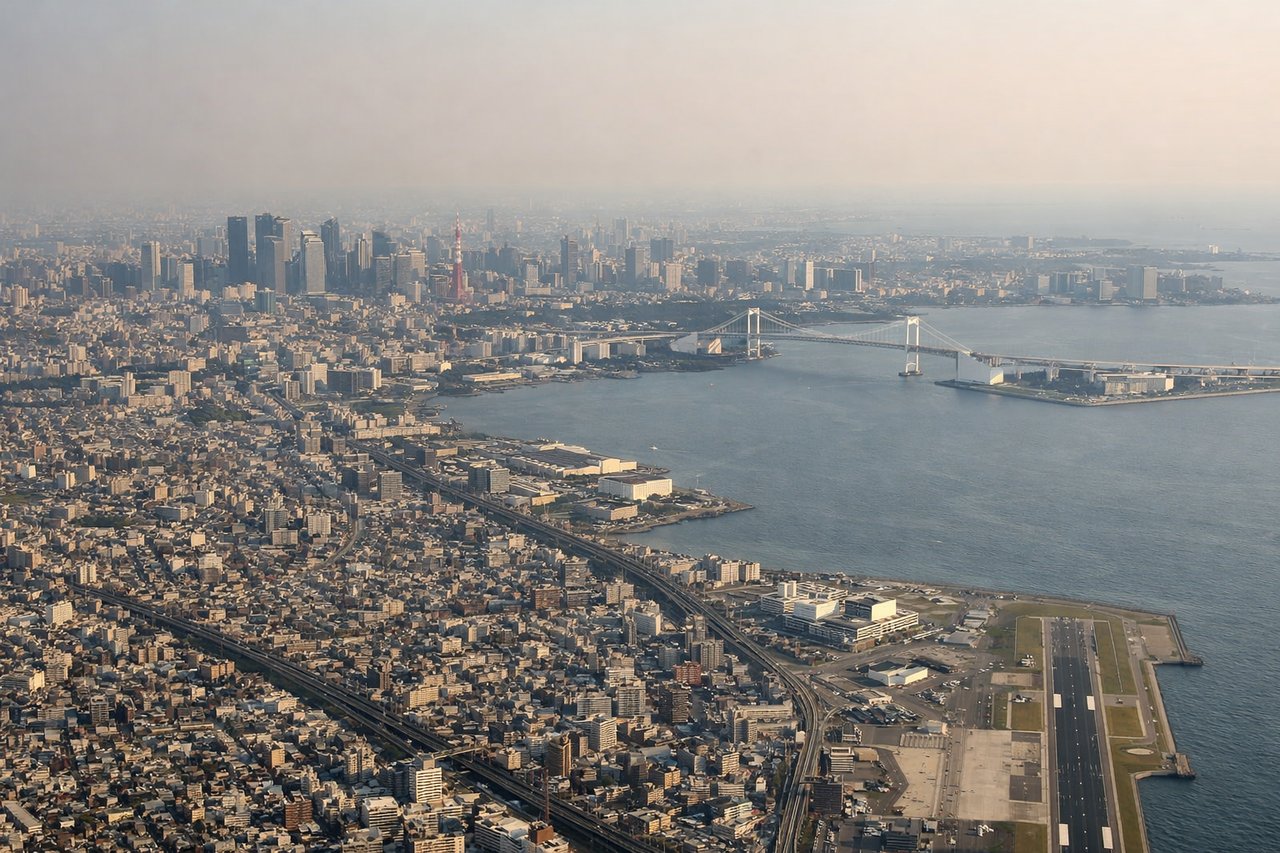
Landing at HND
LEFTLeft side provides views of Tokyo Bay and the Kanto Plain as you descend into Haneda. You'll see the bay's distinctive shape, the Boso Peninsula across the water, and the urban sprawl of Tokyo and surrounding cities.
Will your flight be in sunlight?
Pick a date and time in the Sun Map to watch the sun move across your whole flight.
About This Route
Which side of the plane should I sit on flying from Al Maktoum International Airport (DWC) to Tokyo International (HND)?
Sit on the Left side of the plane for the best views on flights from Dubai to Tokyo. While the takeoff offers excellent Gulf and coastal views on the right, the landing approach on the left provides more sustained scenic interest over Tokyo Bay, the Kanto Plain, and the Boso Peninsula—major geographic features that dominate the final descent. The left side captures the more visually complex and geographically significant portion of the journey.
What can I see during takeoff from Al Maktoum International Airport in Dubai?
During takeoff from Al Maktoum International Airport (DWC), sit on the Right side for the best views. Right side captures the Persian Gulf coastline and the Jebel Ali port complex immediately after departure. You'll see the artificial islands of Palm Jebel Ali and the Dubai coastline receding as you climb northeastward. Notable sights include: Persian Gulf, Palm Jebel Ali artificial islands, Dubai coastline, Jebel Ali port.
What can I see when landing at Tokyo International in Tokyo?
When landing at Tokyo International (HND), sit on the Left side for the best views. Left side provides views of Tokyo Bay and the Kanto Plain as you descend into Haneda. You'll see the bay's distinctive shape, the Boso Peninsula across the water, and the urban sprawl of Tokyo and surrounding cities. Notable sights include: Tokyo Bay, Boso Peninsula, Kanto Plain urban area, Mount Fuji (weather permitting, visible to the west).
How long is the flight from Dubai to Tokyo?
The flight from Al Maktoum International Airport (DWC) to Tokyo International (HND) takes about 7 hours 20 minutes. The shortest flight path between them is 4,954 miles (7,973 km); winds and air traffic control usually add a few percent.
What does the Dubai to Tokyo flight path pass over?
The flight path crosses the Arabian Sea, then the Indian subcontinent's western coast near Gujarat, continues over the Arabian Sea and Indian Ocean toward the Strait of Malacca. You'll pass over or near the Deccan Plateau region, the Bay of Bengal, and the Andaman Sea before reaching Southeast Asia. The Himalayan mountain range remains too far north to be visible on this southerly routing. Over the Indian Ocean, you may see scattered islands and atolls depending on exact flight path. As you approach Japan, the Ryukyu Islands chain becomes visible before reaching Honshu and Tokyo Bay.