Right-side seats capture the most geographically significant features: the Elbe estuary during departure and the Sierra de Guadarrama during arrival. The takeoff view is particularly distinctive, and the landing view compensates with the mountain range's visual impact.
Flown HAM to MAD? Did we get it right?
Flight Path
Hamburg to Madrid is 1,106 miles (1,779 km), a flight of about 2 hours 45 minutes.
The flight path crosses the Rhine-Ruhr industrial region (visible as urban clusters around Cologne and Düsseldorf), then transitions over the Ardennes plateau in Belgium/Luxembourg, continues across the Paris Basin (relatively flat with scattered towns), and approaches the Iberian Peninsula by crossing the Pyrenees foothills before descending into the Madrid plateau. The Pyrenees themselves typically remain south of the standard flight corridor but may be visible on clear days as a distant ridge on the southern horizon during mid-flight.
Great circle distance and headings ›Phase by phase
Takeoff from HAM
RIGHTHamburg typically departs eastbound (runways 05/23 with eastbound preference). Right-side seats face the Elbe River estuary and North Sea approaches during climb-out, offering clear views of the river's distinctive curves and the flat northern German landscape.
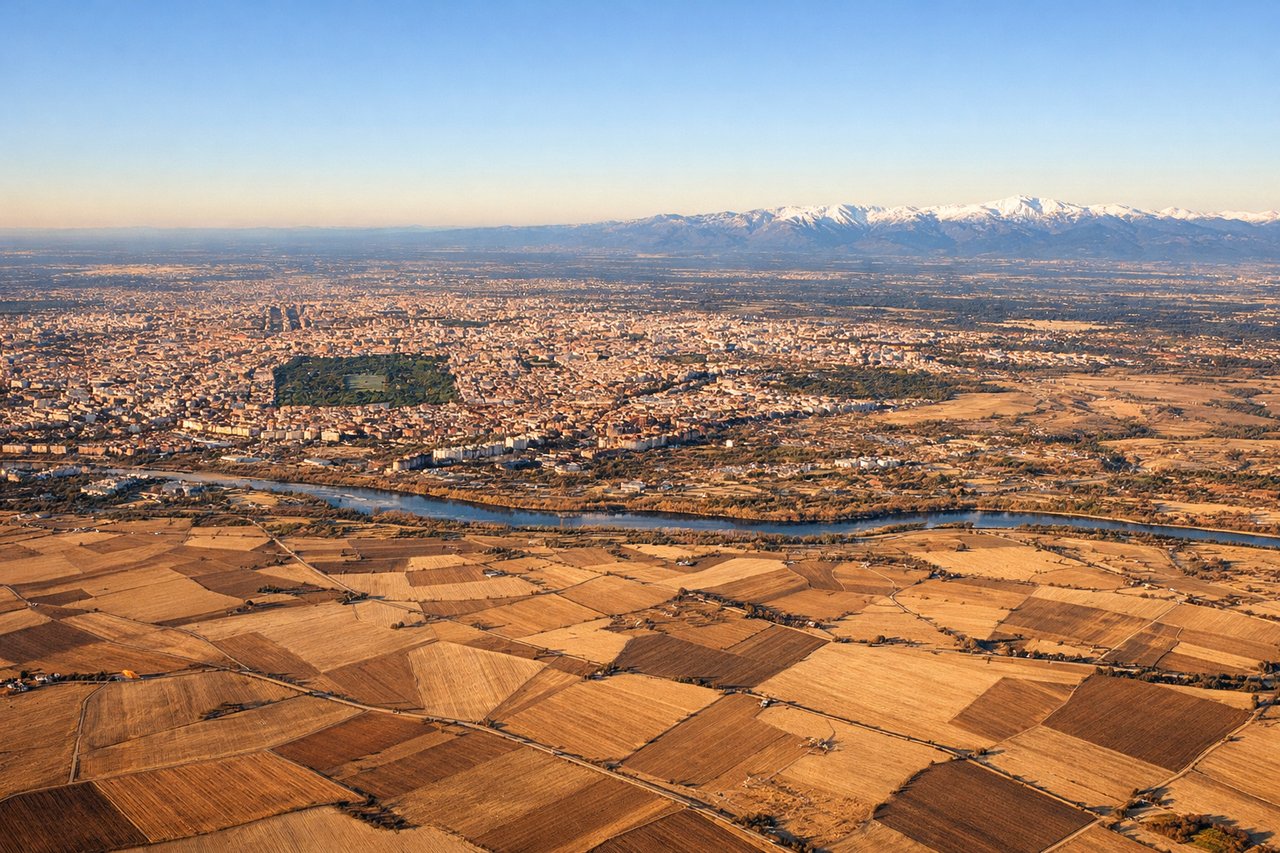
Landing at MAD
LEFTMadrid's Barajas typically uses runways 32L/32R (northwest approaches). Left-side seats during descent offer views of the Sierra de Guadarrama mountain range to the north and the Meseta Central plateau, providing dramatic topographic contrast after hours over flat terrain.
Will your flight be in sunlight?
Pick a date and time in the Sun Map to watch the sun move across your whole flight.
About This Route
Which side of the plane should I sit on flying from Hamburg (HAM) to Barajas (MAD)?
Sit on the Right side of the plane for the best views on flights from Hamburg to Madrid. Right-side seats capture the most geographically significant features: the Elbe estuary during departure and the Sierra de Guadarrama during arrival. The takeoff view is particularly distinctive, and the landing view compensates with the mountain range's visual impact.
What can I see during takeoff from Hamburg in Hamburg?
During takeoff from Hamburg (HAM), sit on the Right side for the best views. Hamburg typically departs eastbound (runways 05/23 with eastbound preference). Right-side seats face the Elbe River estuary and North Sea approaches during climb-out, offering clear views of the river's distinctive curves and the flat northern German landscape. Notable sights include: Elbe River estuary with its characteristic meanders, Alster Lakes (visible as dark water bodies within the city), North Sea coastal flats extending northward, Hamburg's port infrastructure along the river.
What can I see when landing at Barajas in Madrid?
When landing at Barajas (MAD), sit on the Left side for the best views. Madrid's Barajas typically uses runways 32L/32R (northwest approaches). Left-side seats during descent offer views of the Sierra de Guadarrama mountain range to the north and the Meseta Central plateau, providing dramatic topographic contrast after hours over flat terrain. Notable sights include: Sierra de Guadarrama (mountain range north of Madrid with visible peaks), Meseta Central plateau (the high Spanish interior plain), Manzanares River valley, Madrid's urban sprawl and surrounding towns.
How long is the flight from Hamburg to Madrid?
The flight from Hamburg (HAM) to Barajas (MAD) takes about 2 hours 45 minutes. The shortest flight path between them is 1,106 miles (1,779 km); winds and air traffic control usually add a few percent.
What does the Hamburg to Madrid flight path pass over?
The flight path crosses the Rhine-Ruhr industrial region (visible as urban clusters around Cologne and Düsseldorf), then transitions over the Ardennes plateau in Belgium/Luxembourg, continues across the Paris Basin (relatively flat with scattered towns), and approaches the Iberian Peninsula by crossing the Pyrenees foothills before descending into the Madrid plateau. The Pyrenees themselves typically remain south of the standard flight corridor but may be visible on clear days as a distant ridge on the southern horizon during mid-flight.