Kiruna to Stockholm is 569 miles (916 km), a flight of about 1 hour 15 minutes.
While takeoff offers some boreal forest interest on the right, the landing approach provides far more dramatic and varied geography—the Stockholm archipelago is genuinely spectacular from altitude and worth the full flight experience.
Flight Path
The flight path crosses central Swedish Lapland and Norrbotten, passing over the Scandinavian mountain range's eastern foothills (visible as terrain elevation changes), numerous lakes including Torneträsk, Abisko area, and the transition zone between boreal forest and more open subarctic terrain. Around midpoint, you'll cross into Västernorrland and Gävleborg regions where the landscape transitions to slightly lower elevation and more mixed forest. Lake Vänern may be visible to the west depending on exact routing. The descent into Stockholm brings you over the transition from inland forest to the complex geography of the Stockholm archipelago and surrounding lowlands.
Great circle distance and headings ›Phase by phase
Takeoff from KRN
RIGHTKiruna typically departs to the south or southeast. Right-side seats capture the Torne River valley and the transition from boreal forest to the more open terrain south of Kiruna as you climb out.
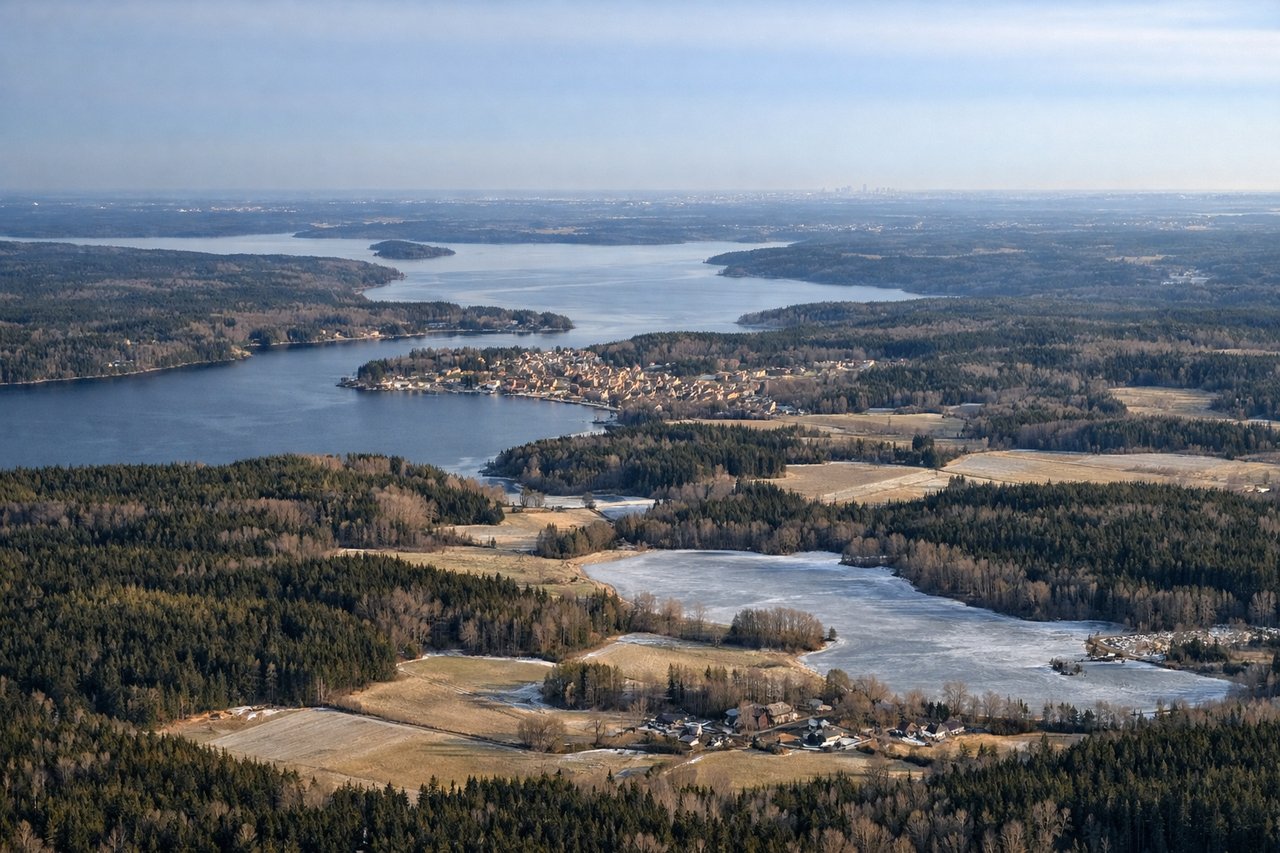
Landing at ARN
LEFTArlanda typically uses runways 01L/19R or 01R/19L depending on wind. On approach from the north, left-side seats offer views of Stockholm's archipelago, Lake Mälaren, and the city's eastern districts as you descend toward the airport.
Landmarks on this routeAll landmarks →
Will your flight be in sunlight?
Pick a date and time in the Sun Map to watch the sun move across your whole flight.
About This Route
Which side of the plane should I sit on flying from Kiruna (KRN) to Arlanda (ARN)?
Sit on the Left side of the plane for the best views on flights from Kiruna to Stockholm. While takeoff offers some boreal forest interest on the right, the landing approach provides far more dramatic and varied geography—the Stockholm archipelago is genuinely spectacular from altitude and worth the full flight experience.
What can I see during takeoff from Kiruna in Kiruna?
During takeoff from Kiruna (KRN), sit on the Right side for the best views. Kiruna typically departs to the south or southeast. Right-side seats capture the Torne River valley and the transition from boreal forest to the more open terrain south of Kiruna as you climb out. Notable sights include: Torne River (visible as a silvery thread below), boreal forest canopy stretching south, Lake Torneträsk to the northwest (visible on left but better framed on right during climb), Abisko National Park terrain.
What can I see when landing at Arlanda in Stockholm?
When landing at Arlanda (ARN), sit on the Left side for the best views. Arlanda typically uses runways 01L/19R or 01R/19L depending on wind. On approach from the north, left-side seats offer views of Stockholm's archipelago, Lake Mälaren, and the city's eastern districts as you descend toward the airport. Notable sights include: Stockholm archipelago (thousands of islands and skerries), Lake Mälaren to the west, Vaxholm fortress area, Stockholm city center and Södermalm district.
How long is the flight from Kiruna to Stockholm?
The flight from Kiruna (KRN) to Arlanda (ARN) takes about 1 hour 15 minutes. The shortest flight path between them is 569 miles (916 km); winds and air traffic control usually add a few percent.
What does the Kiruna to Stockholm flight path pass over?
The flight path crosses central Swedish Lapland and Norrbotten, passing over the Scandinavian mountain range's eastern foothills (visible as terrain elevation changes), numerous lakes including Torneträsk, Abisko area, and the transition zone between boreal forest and more open subarctic terrain. Around midpoint, you'll cross into Västernorrland and Gävleborg regions where the landscape transitions to slightly lower elevation and more mixed forest. Lake Vänern may be visible to the west depending on exact routing. The descent into Stockholm brings you over the transition from inland forest to the complex geography of the Stockholm archipelago and surrounding lowlands.