The left side misses slightly at takeoff but delivers the dominant visual payoff of the flight: a prolonged, unobstructed view of the entire Colorado Front Range on descent into Denver, one of the most dramatic mountain-meets-plains approaches in the continental US.
Flown LAN to DEN? Did we get it right?
Flight Path
Lansing to Denver is 1,059 miles (1,704 km), a flight of about 2 hours 55 minutes.
The flight crosses southern Michigan farmland, northern Indiana and Illinois agricultural plains, then the flat Illinois and Iowa corn belt. Over Nebraska the terrain transitions to the drier mixed-grass high plains. The Platte River valley is visible as a broad shallow braided river system crossing Nebraska. As you enter Colorado the landscape becomes noticeably drier and higher, and the Rocky Mountain Front Range becomes visible on the western horizon roughly 100 miles out from Denver.
Great circle distance and headings ›Phase by phase
Takeoff from LAN
RIGHTLansing's primary departure runway 28R sends aircraft westbound before turning southwest toward Denver. The right side picks up downtown Lansing, the Grand River corridor, and the broader Michigan agricultural patchwork as you climb out. Left side faces north toward less distinctive terrain.
Landing at DEN
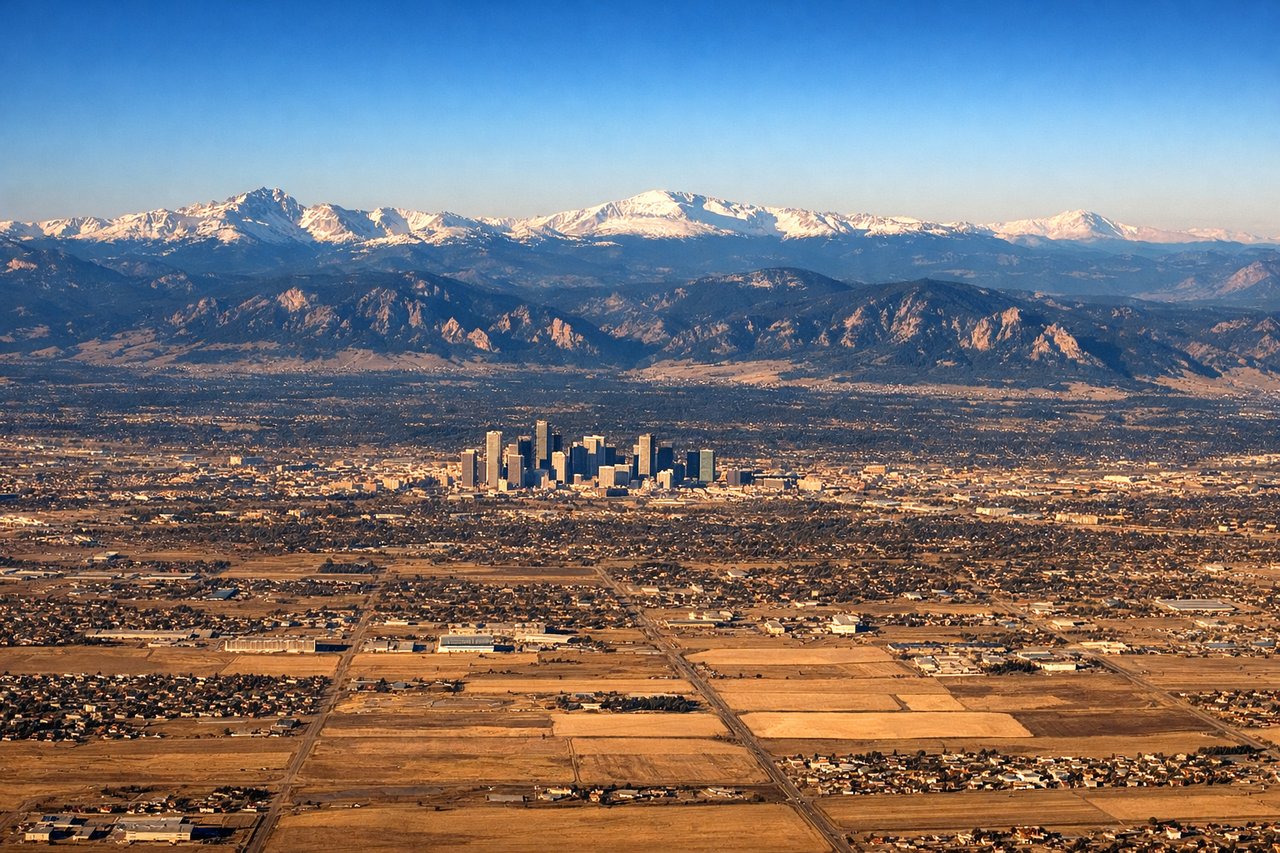
LEFTDenver International sits northeast of the city, and aircraft typically land from the east on runway 34L/35L heading northwest. The left side gives a prolonged view of the entire Front Range — the Rocky Mountains stretching from Pikes Peak in the south to Longs Peak in the north — as you descend across the plains. The right side faces east toward the flat Kansas-Colorado plains with little of interest.
Will your flight be in sunlight?
Pick a date and time in the Sun Map to watch the sun move across your whole flight.
About This Route
Which side of the plane should I sit on flying from Capital City (LAN) to Denver International (DEN)?
Sit on the Left side of the plane for the best views on flights from Lansing to Denver. The left side misses slightly at takeoff but delivers the dominant visual payoff of the flight: a prolonged, unobstructed view of the entire Colorado Front Range on descent into Denver, one of the most dramatic mountain-meets-plains approaches in the continental US.
What can I see during takeoff from Capital City in Lansing?
During takeoff from Capital City (LAN), sit on the Right side for the best views. Lansing's primary departure runway 28R sends aircraft westbound before turning southwest toward Denver. The right side picks up downtown Lansing, the Grand River corridor, and the broader Michigan agricultural patchwork as you climb out. Left side faces north toward less distinctive terrain. Notable sights include: Downtown Lansing skyline, Grand River bends, Michigan State University campus in East Lansing, agricultural grid of mid-Michigan.
What can I see when landing at Denver International in Denver?
When landing at Denver International (DEN), sit on the Left side for the best views. Denver International sits northeast of the city, and aircraft typically land from the east on runway 34L/35L heading northwest. The left side gives a prolonged view of the entire Front Range — the Rocky Mountains stretching from Pikes Peak in the south to Longs Peak in the north — as you descend across the plains. The right side faces east toward the flat Kansas-Colorado plains with little of interest. Notable sights include: Front Range of the Rocky Mountains, Longs Peak and Indian Peaks to the northwest, Pikes Peak to the south, Denver metro grid and downtown skyline.
How long is the flight from Lansing to Denver?
The flight from Capital City (LAN) to Denver International (DEN) takes about 2 hours 55 minutes. The shortest flight path between them is 1,059 miles (1,704 km); winds and air traffic control usually add a few percent.
What does the Lansing to Denver flight path pass over?
The flight crosses southern Michigan farmland, northern Indiana and Illinois agricultural plains, then the flat Illinois and Iowa corn belt. Over Nebraska the terrain transitions to the drier mixed-grass high plains. The Platte River valley is visible as a broad shallow braided river system crossing Nebraska. As you enter Colorado the landscape becomes noticeably drier and higher, and the Rocky Mountain Front Range becomes visible on the western horizon roughly 100 miles out from Denver.