Right-side seats offer superior views on both legs: Alps and Rhône valley on departure, then the Danube, Vienna Woods, and city approach on arrival. Left side provides only flat plains on both segments.
Flight Path
The flight path crosses the Jura Mountains (visible as a lower, more fragmented range compared to the Alps, roughly 30 minutes after departure), then transitions over the Swiss plateau and into the Alpine foothills. Around the midpoint, the Appenzell Alps and eastern Swiss Alps appear to the right. The route then descends into the Danube valley, passing over the Bohemian Massif's southern edge before reaching the Vienna basin. The Danube itself becomes visible in the final 30 minutes of approach as a major geographic anchor.
Great circle distance and headings ›_Panoramica_del_centro_della_citt%C3%A0_dal_lago.jpg?width=600)


.jpg?width=600)

Phase by phase
Takeoff from LYS
RIGHTLyon typically departs eastbound (runways 04L/04R or 22L/22R depending on wind). Right-side seats face the Alps as you climb out, with the Rhône valley visible below. Left side shows only the flat Rhône plain westward.
Landing at VIE
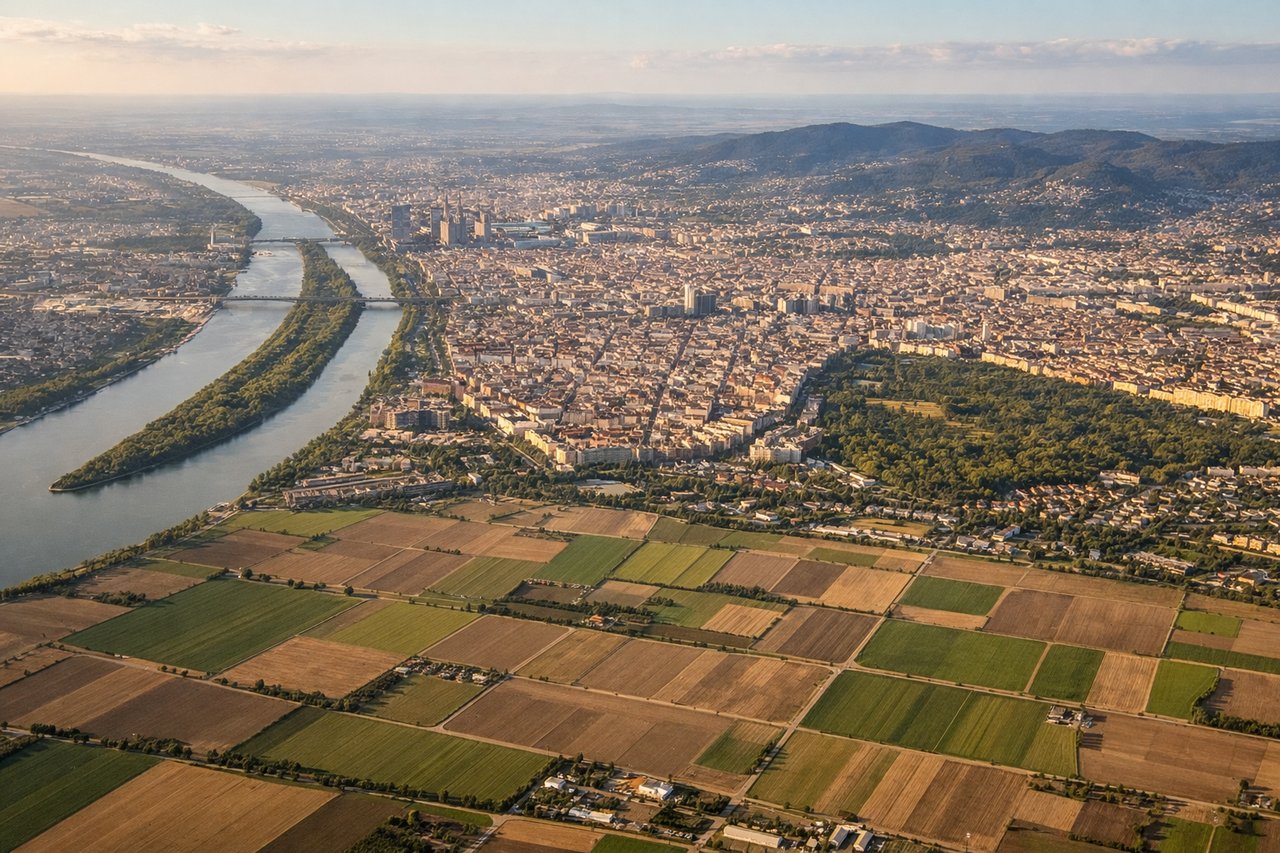
RIGHTVienna typically lands westbound (runways 11L/11R or 29L/29R). Right-side seats on approach show the Danube river, the Vienna Woods (Wienerwald), and the city's eastern districts. Left side shows only flat Hungarian plain.
Landmarks on this routeAll landmarks →
Will your flight be in sunlight?
See exactly which side of the plane gets sun and shade at your departure time.
About This Route
Which side of the plane should I sit on flying from Saint Exupery (LYS) to Schwechat (VIE)?
Sit on the Right side of the plane for the best views on flights from Lyon to Vienna. Right-side seats offer superior views on both legs: Alps and Rhône valley on departure, then the Danube, Vienna Woods, and city approach on arrival. Left side provides only flat plains on both segments.
What can I see during takeoff from Saint Exupery in Lyon?
During takeoff from Saint Exupery (LYS), sit on the Right side for the best views. Lyon typically departs eastbound (runways 04L/04R or 22L/22R depending on wind). Right-side seats face the Alps as you climb out, with the Rhône valley visible below. Left side shows only the flat Rhône plain westward. Notable sights include: Mont Blanc (distant, 60+ miles northeast on horizon), Massif Central foothills (south), Rhône river valley (directly below during initial climb), Lake Bourget (visible 30 miles southeast if weather clear).
What can I see when landing at Schwechat in Vienna?
When landing at Schwechat (VIE), sit on the Right side for the best views. Vienna typically lands westbound (runways 11L/11R or 29L/29R). Right-side seats on approach show the Danube river, the Vienna Woods (Wienerwald), and the city's eastern districts. Left side shows only flat Hungarian plain. Notable sights include: Danube river (prominent S-curve through Vienna), Vienna Woods/Wienerwald (forested ridge southwest of city), Danube floodplain wetlands (east of river), city center and Stephansdom district (visible as urban density).
How long is the flight from Lyon to Vienna?
The flight from Saint Exupery (LYS) to Schwechat (VIE) takes Approximately 2 hours 15 minutes.
What does the Lyon to Vienna flight path pass over?
The flight path crosses the Jura Mountains (visible as a lower, more fragmented range compared to the Alps, roughly 30 minutes after departure), then transitions over the Swiss plateau and into the Alpine foothills. Around the midpoint, the Appenzell Alps and eastern Swiss Alps appear to the right. The route then descends into the Danube valley, passing over the Bohemian Massif's southern edge before reaching the Vienna basin. The Danube itself becomes visible in the final 30 minutes of approach as a major geographic anchor.