While the left side wins at takeoff for the Alpine views, the right side delivers consistently throughout the flight — the French Massif Central, the Pyrenees crossing from north to south, and then the dramatic Basque coastline and Bay of Biscay on descent into Bilbao. The Pyrenees view alone from the right side mid-flight is exceptional.
Flight Path
The route tracks west-southwest over Baden-Württemberg and then into France, crossing the Burgundy plateau and the upper Loire basin. The Massif Central highlands are visible to the south as you cross central France. The most dramatic feature is the Pyrenees crossing near the western end of the range, where the mountains are lower but still clearly defined, before descending over the Basque Country into Bilbao.
Great circle distance and headings ›

_Panoramica_del_centro_della_citt%C3%A0_dal_lago.jpg?width=600)

Phase by phase
Takeoff from MUC
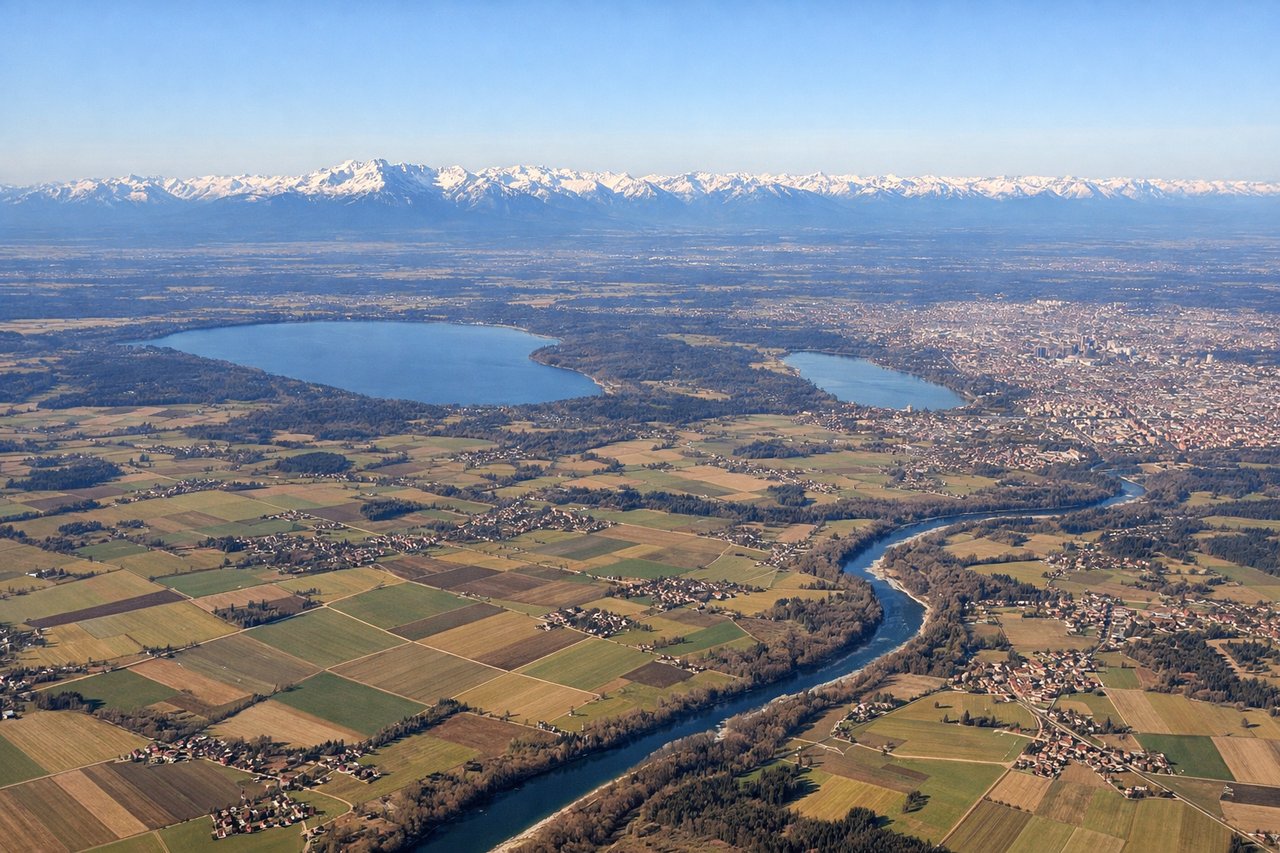
LEFTMunich departures on runway 26L/26R head westward, and the left side gives you a clear southward view toward the Bavarian Alps, including the Zugspitze massif and the Inn Valley. The alpine foothills and the Ammersee and Starnberger See lakes are also visible on the left as you climb out.
Landing at BIO
RIGHTBilbao's runway 30 approach comes in from the southeast over the Cantabrian Mountains, and the right side faces north toward the Bay of Biscay and the Basque coastline. You get a clear view of the Nervión estuary, the city of Bilbao itself, and the Atlantic coastline as you descend.
Landmarks on this routeAll landmarks →
Will your flight be in sunlight?
See exactly which side of the plane gets sun and shade at your departure time.
About This Route
Which side of the plane should I sit on flying from Munich (MUC) to Bilbao (BIO)?
Sit on the Right side of the plane for the best views on flights from Munich to Bilbao. While the left side wins at takeoff for the Alpine views, the right side delivers consistently throughout the flight — the French Massif Central, the Pyrenees crossing from north to south, and then the dramatic Basque coastline and Bay of Biscay on descent into Bilbao. The Pyrenees view alone from the right side mid-flight is exceptional.
What can I see during takeoff from Munich in Munich?
During takeoff from Munich (MUC), sit on the Left side for the best views. Munich departures on runway 26L/26R head westward, and the left side gives you a clear southward view toward the Bavarian Alps, including the Zugspitze massif and the Inn Valley. The alpine foothills and the Ammersee and Starnberger See lakes are also visible on the left as you climb out. Notable sights include: Zugspitze massif to the south, Starnberger See, Ammersee, Bavarian foothills.
What can I see when landing at Bilbao in Bilbao?
When landing at Bilbao (BIO), sit on the Right side for the best views. Bilbao's runway 30 approach comes in from the southeast over the Cantabrian Mountains, and the right side faces north toward the Bay of Biscay and the Basque coastline. You get a clear view of the Nervión estuary, the city of Bilbao itself, and the Atlantic coastline as you descend. Notable sights include: Bay of Biscay, Nervión estuary, Bilbao city center, Cantabrian Mountains.
How long is the flight from Munich to Bilbao?
The flight from Munich (MUC) to Bilbao (BIO) takes Approximately 2 hours 15 minutes.
What does the Munich to Bilbao flight path pass over?
The route tracks west-southwest over Baden-Württemberg and then into France, crossing the Burgundy plateau and the upper Loire basin. The Massif Central highlands are visible to the south as you cross central France. The most dramatic feature is the Pyrenees crossing near the western end of the range, where the mountains are lower but still clearly defined, before descending over the Basque Country into Bilbao.