Right-side seats capture the most dramatic geography: Penang Island and the Strait of Malacca on departure, then the transition over open water toward Phang Nga Bay's karsts on approach. While landing favors the left, the takeoff advantage and the scenic water crossing make right-side the better overall choice.
Flight Path
The flight path crosses the Strait of Malacca northwestward, then transitions over open Andaman Sea. Notable midpoint features include the Sumatran coast (visible as a distant landmass to the west), the open waters of the Andaman Sea, and the gradual approach to Phang Nga Bay's distinctive karst topography as the aircraft descends toward Phuket.
Great circle distance and headings ›


Phase by phase
Takeoff from PEN
RIGHTPenang International typically departs runway 09L/27R or 09R/27L depending on wind. Northwesterly departures (runway 27) favor right-side views of the Strait of Malacca and Penang Island's western coastline. Southeasterly departures (runway 09) still offer right-side views of the island's interior and eastern approaches.
Landing at HKT
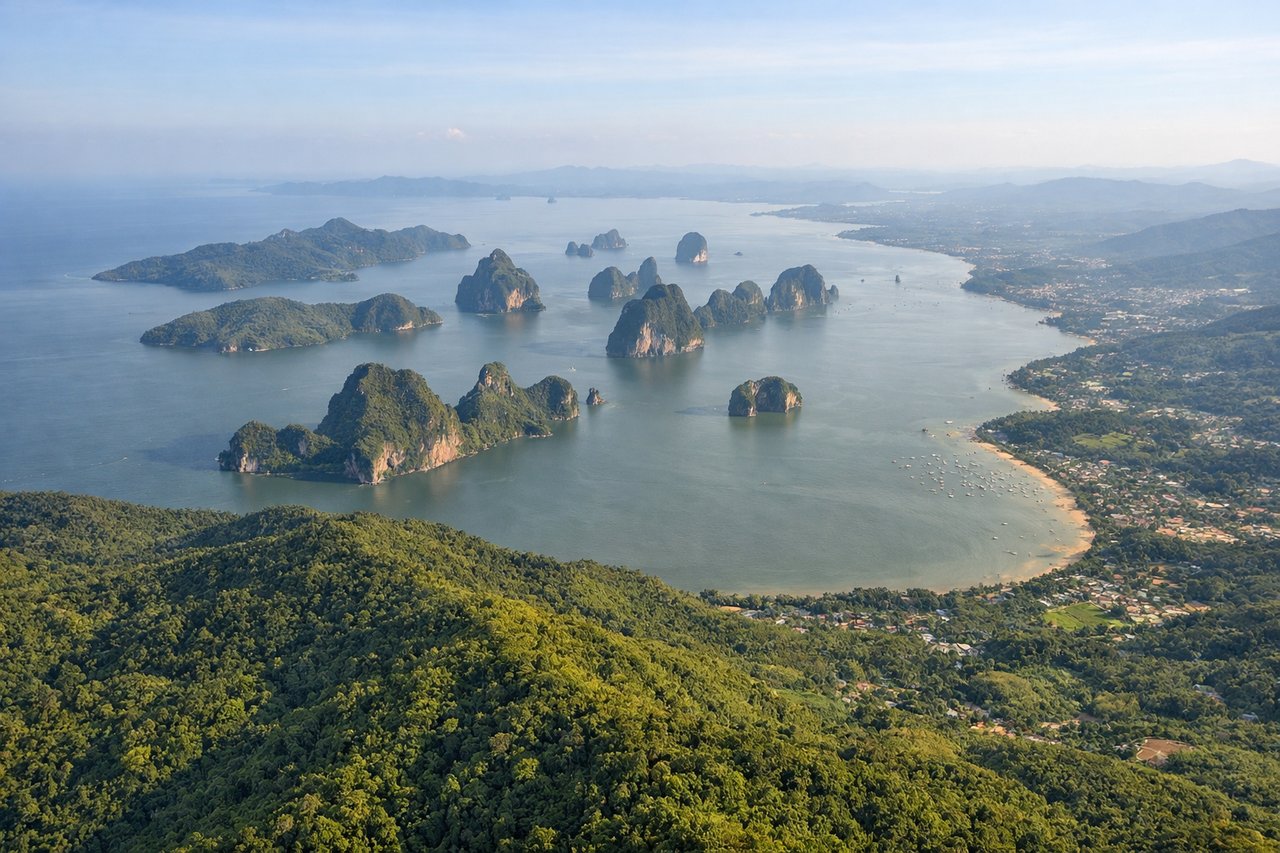
LEFTPhuket International uses runways 03L/21R and 03R/21L. Approach vectors typically bring aircraft from the northeast over Phang Nga Bay. Left-side seats offer views of the bay's distinctive limestone karsts, Phuket Island itself, and the Andaman Sea during descent.
Landmarks on this routeAll landmarks →
Will your flight be in sunlight?
See exactly which side of the plane gets sun and shade at your departure time.
About This Route
Which side of the plane should I sit on flying from Penang International (PEN) to Phuket International (HKT)?
Sit on the Right side of the plane for the best views on flights from Penang to Phuket. Right-side seats capture the most dramatic geography: Penang Island and the Strait of Malacca on departure, then the transition over open water toward Phang Nga Bay's karsts on approach. While landing favors the left, the takeoff advantage and the scenic water crossing make right-side the better overall choice.
What can I see during takeoff from Penang International in Penang?
During takeoff from Penang International (PEN), sit on the Right side for the best views. Penang International typically departs runway 09L/27R or 09R/27L depending on wind. Northwesterly departures (runway 27) favor right-side views of the Strait of Malacca and Penang Island's western coastline. Southeasterly departures (runway 09) still offer right-side views of the island's interior and eastern approaches. Notable sights include: Penang Island (distinctive elongated shape below), Strait of Malacca (wide water body to the west), Kedah Peak (distant northern horizon), mainland Peninsular Malaysia (eastern side).
What can I see when landing at Phuket International in Phuket?
When landing at Phuket International (HKT), sit on the Left side for the best views. Phuket International uses runways 03L/21R and 03R/21L. Approach vectors typically bring aircraft from the northeast over Phang Nga Bay. Left-side seats offer views of the bay's distinctive limestone karsts, Phuket Island itself, and the Andaman Sea during descent. Notable sights include: Phang Nga Bay limestone karsts (dramatic rock formations), Phuket Island (main landmass), Andaman Sea (open water to the southwest), Phang Nga Province mainland (northern approach).
How long is the flight from Penang to Phuket?
The flight from Penang International (PEN) to Phuket International (HKT) takes Approximately 1 hour 15 minutes.
What does the Penang to Phuket flight path pass over?
The flight path crosses the Strait of Malacca northwestward, then transitions over open Andaman Sea. Notable midpoint features include the Sumatran coast (visible as a distant landmass to the west), the open waters of the Andaman Sea, and the gradual approach to Phang Nga Bay's distinctive karst topography as the aircraft descends toward Phuket.