Santiago to Barcelona is 549 miles (883 km), a flight of about 1 hour 15 minutes.
While takeoff favors the right for coastal views, the landing approach on left seats provides the more dramatic and memorable visual—Montserrat's distinctive geology is a genuine highlight. The flight path itself (southeast across central Spain) doesn't offer exceptional features from either side, making the landing experience the deciding factor.
Flight Path
The flight crosses central Spain at altitude, passing over the Meseta Central plateau. Notable features include the Duero River basin (visible as a linear valley system), scattered mountain ranges including the Sistema Central (Sierra de Guadarrama area) to the east, and the transition from Castilian plains to the more complex terrain of Catalonia. At cruise altitude (around 25,000-30,000 feet), these features appear as subtle terrain variations and river valleys rather than dramatic landmarks. The Ebro River valley becomes visible as the aircraft approaches Catalonia from the west.
Great circle distance and headings ›Phase by phase
Takeoff from SCQ
RIGHTSantiago typically departs runway 32 (northwest heading). Right-side seats face toward the Atlantic coast and the Galician rias (coastal inlets), while left seats look inland over less distinctive terrain. The coastal geography is far more visually interesting during climb-out.
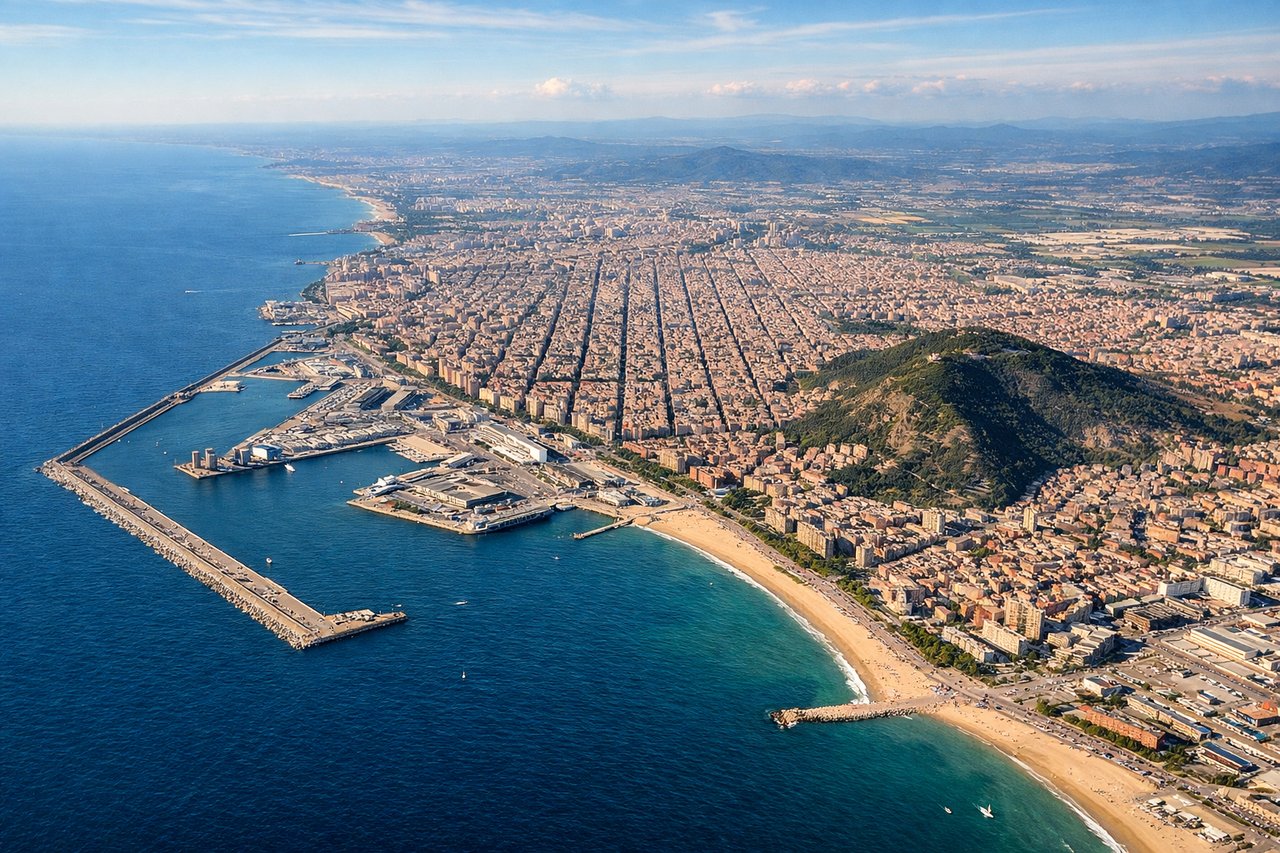
Landing at BCN
LEFTBarcelona typically lands runway 25L or 25R (westward approach). Left-side seats on descent provide views of the Montserrat massif and the Llobregat River valley, which frame the approach into the city. Right seats face toward the Mediterranean but offer less distinctive terrain during final approach.
Landmarks on this routeAll landmarks →
Will your flight be in sunlight?
Pick a date and time in the Sun Map to watch the sun move across your whole flight.
About This Route
Which side of the plane should I sit on flying from Santiago (SCQ) to Barcelona (BCN)?
Sit on the Left side of the plane for the best views on flights from Santiago to Barcelona. While takeoff favors the right for coastal views, the landing approach on left seats provides the more dramatic and memorable visual—Montserrat's distinctive geology is a genuine highlight. The flight path itself (southeast across central Spain) doesn't offer exceptional features from either side, making the landing experience the deciding factor.
What can I see during takeoff from Santiago in Santiago?
During takeoff from Santiago (SCQ), sit on the Right side for the best views. Santiago typically departs runway 32 (northwest heading). Right-side seats face toward the Atlantic coast and the Galician rias (coastal inlets), while left seats look inland over less distinctive terrain. The coastal geography is far more visually interesting during climb-out. Notable sights include: Ría de Arousa (largest Galician estuary), Atlantic coastline with characteristic fjord-like inlets, Sierra del Suido mountains to the south, Vigo estuary visible further south.
What can I see when landing at Barcelona in Barcelona?
When landing at Barcelona (BCN), sit on the Left side for the best views. Barcelona typically lands runway 25L or 25R (westward approach). Left-side seats on descent provide views of the Montserrat massif and the Llobregat River valley, which frame the approach into the city. Right seats face toward the Mediterranean but offer less distinctive terrain during final approach. Notable sights include: Montserrat mountain range (distinctive jagged peaks), Llobregat River valley and delta, Barcelona's urban sprawl extending toward the coast, Mediterranean Sea.
How long is the flight from Santiago to Barcelona?
The flight from Santiago (SCQ) to Barcelona (BCN) takes about 1 hour 15 minutes. The shortest flight path between them is 549 miles (883 km); winds and air traffic control usually add a few percent.
What does the Santiago to Barcelona flight path pass over?
The flight crosses central Spain at altitude, passing over the Meseta Central plateau. Notable features include the Duero River basin (visible as a linear valley system), scattered mountain ranges including the Sistema Central (Sierra de Guadarrama area) to the east, and the transition from Castilian plains to the more complex terrain of Catalonia. At cruise altitude (around 25,000-30,000 feet), these features appear as subtle terrain variations and river valleys rather than dramatic landmarks. The Ebro River valley becomes visible as the aircraft approaches Catalonia from the west.