While the right side offers excellent Vienna departure views, the left side provides superior scenery for the majority of the transatlantic flight and the critical Montreal approach. The St. Lawrence River and Laurentian Mountains on descent are more visually striking than the Danube departure, and left-side seats capture more of the North Atlantic crossing and eastern Canadian geography.
Flown VIE to YUL? Did we get it right?
Flight Path
Vienna to Montreal is 4,016 miles (6,463 km), a flight of about 10 hours.
The flight path crosses the Atlantic Ocean for approximately 6-7 hours. Notable geographic features along the route include: the Irish coast and Celtic Sea (visible 2-3 hours after departure), the Atlantic Ocean (featureless water for the majority of the crossing), Greenland's eastern coast and glaciers (visible if flying the northern great-circle route, appearing as white ice sheets and dark rock), the Canadian Arctic islands and Baffin Island (visible on approach to North America, showing tundra and fjords), and the Canadian Shield's boreal forests (visible during descent into eastern Canada, appearing as dense green forest with visible lakes and rivers).
Great circle distance and headings ›

Phase by phase
Takeoff from VIE
RIGHTRight-side seats offer views of the Danube River as it curves through Vienna's outskirts during northwestward climb-out. The river's distinctive meanders and the flat Pannonian Basin stretching toward the horizon provide clear geographic context for the first 10-15 minutes of flight.
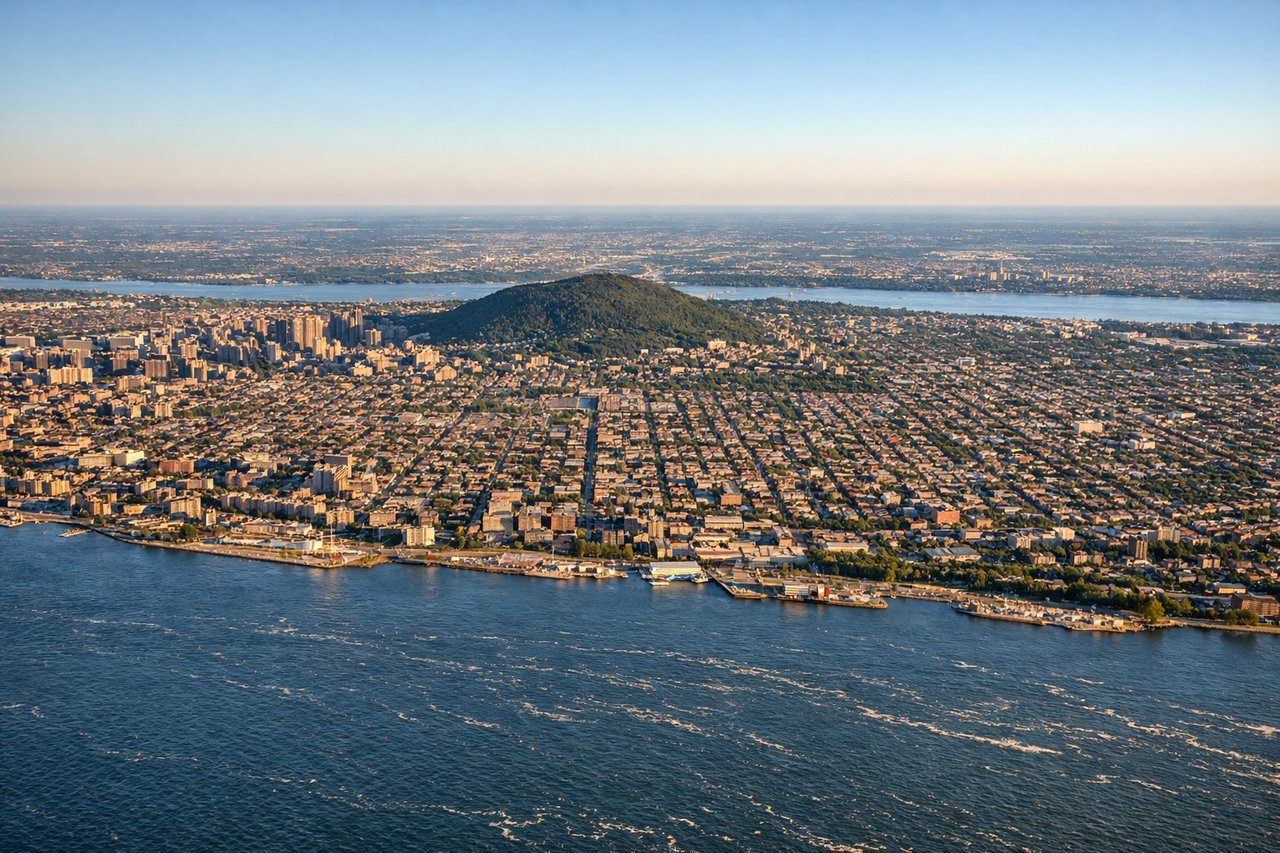
Landing at YUL
LEFTLeft-side seats provide excellent views during the final descent into Montreal. As the aircraft approaches from the northeast, the St. Lawrence River becomes prominent, and the Laurentian Mountains are visible to the north. The urban sprawl of Montreal and surrounding areas fills the view during the final 20 minutes.
Will your flight be in sunlight?
Pick a date and time in the Sun Map to watch the sun move across your whole flight.
About This Route
Which side of the plane should I sit on flying from Schwechat (VIE) to Montreal International Dorval (YUL)?
Sit on the Left side of the plane for the best views on flights from Vienna to Montreal. While the right side offers excellent Vienna departure views, the left side provides superior scenery for the majority of the transatlantic flight and the critical Montreal approach. The St. Lawrence River and Laurentian Mountains on descent are more visually striking than the Danube departure, and left-side seats capture more of the North Atlantic crossing and eastern Canadian geography.
What can I see during takeoff from Schwechat in Vienna?
During takeoff from Schwechat (VIE), sit on the Right side for the best views. Right-side seats offer views of the Danube River as it curves through Vienna's outskirts during northwestward climb-out. The river's distinctive meanders and the flat Pannonian Basin stretching toward the horizon provide clear geographic context for the first 10-15 minutes of flight. Notable sights include: Danube River (flowing northeast through Vienna), Vienna city sprawl (visible as urban grid below), Carpathian Mountains (distant northeastern horizon), Pannonian Plain (flat terrain extending westward).
What can I see when landing at Montreal International Dorval in Montreal?
When landing at Montreal International Dorval (YUL), sit on the Left side for the best views. Left-side seats provide excellent views during the final descent into Montreal. As the aircraft approaches from the northeast, the St. Lawrence River becomes prominent, and the Laurentian Mountains are visible to the north. The urban sprawl of Montreal and surrounding areas fills the view during the final 20 minutes. Notable sights include: St. Lawrence River (flowing southwest toward the Atlantic), Laurentian Mountains (northern horizon, part of the Canadian Shield), Montreal city (urban grid and downtown core), Lake Saint-Louis (western approach to the river).
How long is the flight from Vienna to Montreal?
The flight from Schwechat (VIE) to Montreal International Dorval (YUL) takes about 10 hours. The shortest flight path between them is 4,016 miles (6,463 km); winds and air traffic control usually add a few percent.
What does the Vienna to Montreal flight path pass over?
The flight path crosses the Atlantic Ocean for approximately 6-7 hours. Notable geographic features along the route include: the Irish coast and Celtic Sea (visible 2-3 hours after departure), the Atlantic Ocean (featureless water for the majority of the crossing), Greenland's eastern coast and glaciers (visible if flying the northern great-circle route, appearing as white ice sheets and dark rock), the Canadian Arctic islands and Baffin Island (visible on approach to North America, showing tundra and fjords), and the Canadian Shield's boreal forests (visible during descent into eastern Canada, appearing as dense green forest with visible lakes and rivers).