While Edmonton's takeoff offers modest urban and river valley scenery, the landing into Montego Bay with Caribbean coastal views, reef patterns, and the dramatic ocean-to-land transition provides significantly more visual interest and variety across the full flight. The right side captures the most distinctive moment of the journey—the approach to a tropical island destination with genuine scenic appeal.
Flown YEG to MBJ? Did we get it right?
Flight Path
Edmonton to Montego Bay is 3,066 miles (4,934 km), a flight of about 5 hours 15 minutes.
The flight path crosses the Great Lakes region (Lake Michigan, Lake Huron visible from altitude), the Appalachian Mountains in eastern Tennessee and Kentucky, the Gulf of Mexico with its distinctive warm-water color, and the Yucatan Peninsula before descending toward Jamaica. The Gulf crossing dominates the middle 2.5 hours with open water, but the Appalachian foothills during the eastern US portion and the Yucatan's flat limestone terrain with cenote patterns provide brief scenic interest.
Great circle distance and headings ›Phase by phase
Takeoff from YEG
LEFTLeft side captures Edmonton's urban sprawl and the North Saskatchewan River valley during climb-out, with some rolling terrain visible to the northwest. Right side faces open prairie with minimal visual interest.
Landing at MBJ
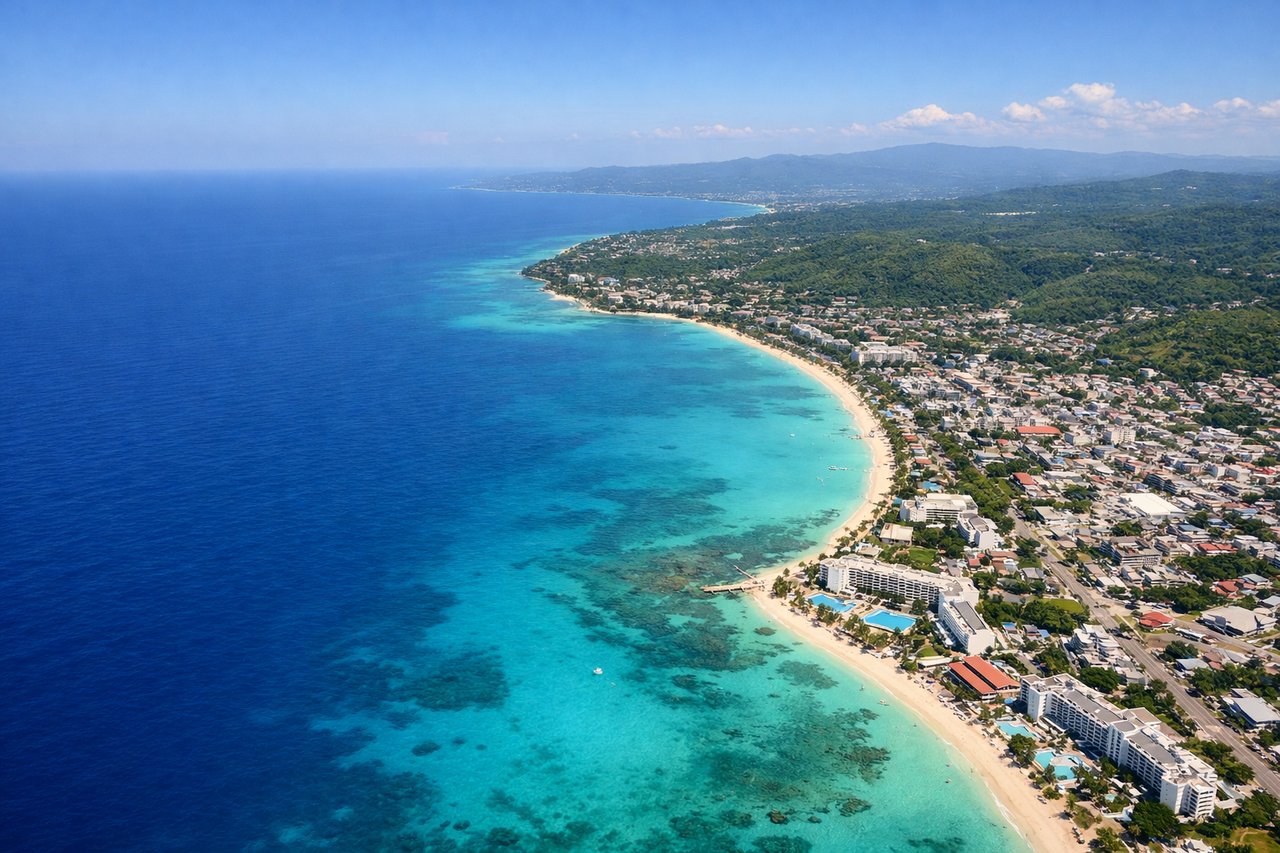
RIGHTRight side offers the Caribbean approach into Montego Bay with coastal views, reef patterns, and the dramatic transition from open ocean to the Jamaican coastline. Left side sees only open Atlantic Ocean for the final descent.
Will your flight be in sunlight?
Pick a date and time in the Sun Map to watch the sun move across your whole flight.
About This Route
Which side of the plane should I sit on flying from Edmonton International (YEG) to Sangster International (MBJ)?
Sit on the Right side of the plane for the best views on flights from Edmonton to Montego Bay. While Edmonton's takeoff offers modest urban and river valley scenery, the landing into Montego Bay with Caribbean coastal views, reef patterns, and the dramatic ocean-to-land transition provides significantly more visual interest and variety across the full flight. The right side captures the most distinctive moment of the journey—the approach to a tropical island destination with genuine scenic appeal.
What can I see during takeoff from Edmonton International in Edmonton?
During takeoff from Edmonton International (YEG), sit on the Left side for the best views. Left side captures Edmonton's urban sprawl and the North Saskatchewan River valley during climb-out, with some rolling terrain visible to the northwest. Right side faces open prairie with minimal visual interest. Notable sights include: North Saskatchewan River valley, Edmonton city grid, Beaver Lake to the northeast, rolling parkland transitioning to boreal forest.
What can I see when landing at Sangster International in Montego Bay?
When landing at Sangster International (MBJ), sit on the Right side for the best views. Right side offers the Caribbean approach into Montego Bay with coastal views, reef patterns, and the dramatic transition from open ocean to the Jamaican coastline. Left side sees only open Atlantic Ocean for the final descent. Notable sights include: Montego Bay harbor and cruise ship anchorage, Jamaican north coast with white sand beaches, coral reef patterns visible in shallow turquoise water, Doctor's Cave Beach area.
How long is the flight from Edmonton to Montego Bay?
The flight from Edmonton International (YEG) to Sangster International (MBJ) takes about 5 hours 15 minutes. The shortest flight path between them is 3,066 miles (4,934 km); winds and air traffic control usually add a few percent.
What does the Edmonton to Montego Bay flight path pass over?
The flight path crosses the Great Lakes region (Lake Michigan, Lake Huron visible from altitude), the Appalachian Mountains in eastern Tennessee and Kentucky, the Gulf of Mexico with its distinctive warm-water color, and the Yucatan Peninsula before descending toward Jamaica. The Gulf crossing dominates the middle 2.5 hours with open water, but the Appalachian foothills during the eastern US portion and the Yucatan's flat limestone terrain with cenote patterns provide brief scenic interest.