While landing offers spectacular Saronic Gulf and mountain views on the left, the takeoff provides more sustained scenic interest—the Nile Delta's geometric beauty and Cairo's urban scale are visually distinctive and occupy more of the flight's initial phase. Right-side seats capture the most dramatic departure scenery.
Flown CAI to ATH? Did we get it right?
Flight Path
Cairo to Athens is 688 miles (1,108 km), a flight of about 2 hours 5 minutes.
The flight crosses the eastern Mediterranean Sea for roughly 1.5 hours. Notable features include the Crete island chain (visible as a long east-west landmass if flying at southern latitudes), the Peloponnese peninsula's southern coast, and the transition from Egyptian airspace to Greek airspace over open water. The Aegean Sea's island-scattered character becomes increasingly visible as the aircraft approaches Greek airspace, with the Cyclades and Sporades archipelagos appearing as small landmasses dotting the blue water during the final approach phase.
Great circle distance and headings ›


Phase by phase
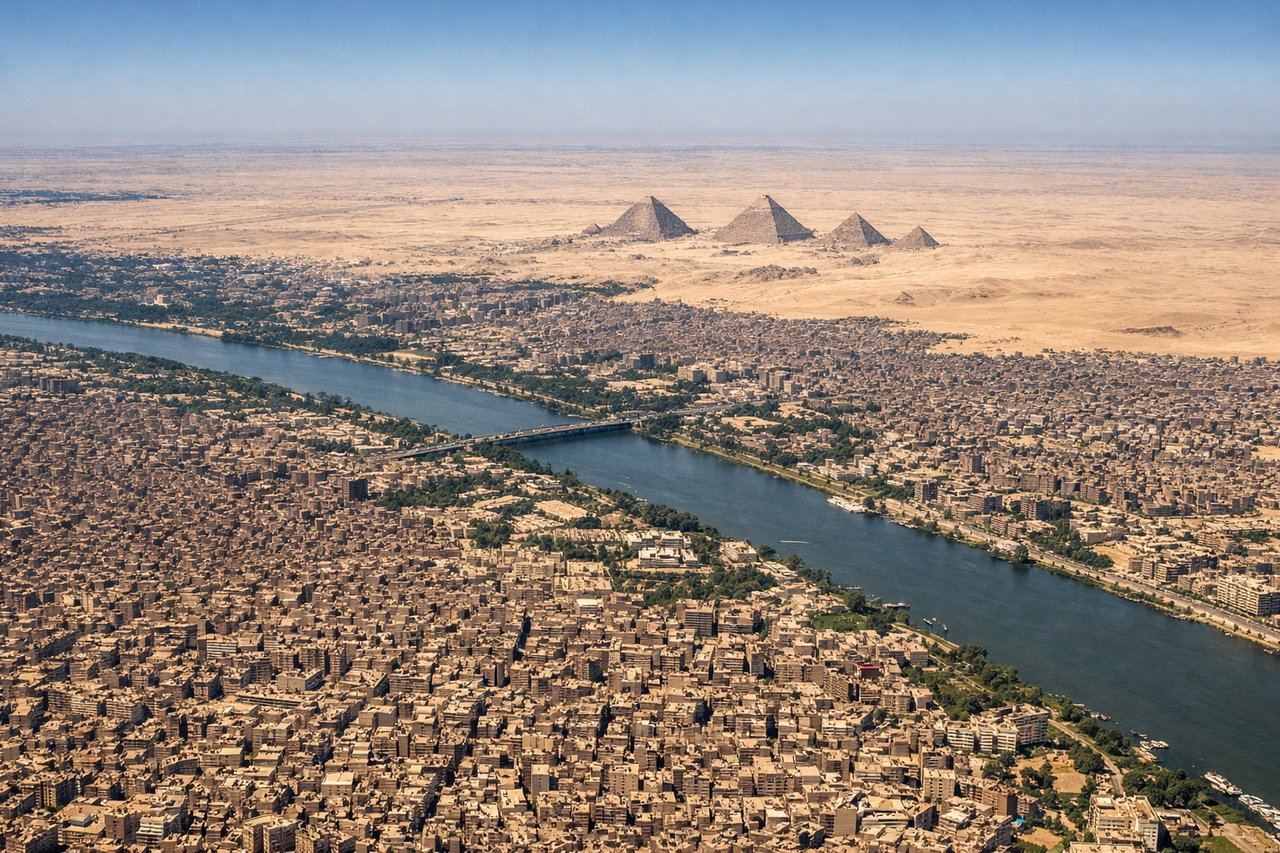
Takeoff from CAI
RIGHTRight-side seats offer views of the Nile Delta's intricate waterways and agricultural fields immediately after departure, plus the sprawl of greater Cairo. The northbound climb-out trajectory from CAI naturally presents these features on the right wing.
Landing at ATH
LEFTLeft-side seats provide excellent views during the southbound descent into Athens, showing the Saronic Gulf, the Attica coastline, and the Hymettus and Penteli mountain ranges that frame the Athens basin. The approach path naturally presents these features on the left.
Will your flight be in sunlight?
Pick a date and time in the Sun Map to watch the sun move across your whole flight.
About This Route
Which side of the plane should I sit on flying from Cairo International (CAI) to Athens International Eleftherios Venizelos (ATH)?
Sit on the Right side of the plane for the best views on flights from Cairo to Athens. While landing offers spectacular Saronic Gulf and mountain views on the left, the takeoff provides more sustained scenic interest—the Nile Delta's geometric beauty and Cairo's urban scale are visually distinctive and occupy more of the flight's initial phase. Right-side seats capture the most dramatic departure scenery.
What can I see during takeoff from Cairo International in Cairo?
During takeoff from Cairo International (CAI), sit on the Right side for the best views. Right-side seats offer views of the Nile Delta's intricate waterways and agricultural fields immediately after departure, plus the sprawl of greater Cairo. The northbound climb-out trajectory from CAI naturally presents these features on the right wing. Notable sights include: Nile Delta with its distinctive branching channels, Cairo urban sprawl and Helwan industrial zone to the south, Lake Manzala (shallow lagoon) to the northeast, Suez Canal corridor in the far distance.
What can I see when landing at Athens International Eleftherios Venizelos in Athens?
When landing at Athens International Eleftherios Venizelos (ATH), sit on the Left side for the best views. Left-side seats provide excellent views during the southbound descent into Athens, showing the Saronic Gulf, the Attica coastline, and the Hymettus and Penteli mountain ranges that frame the Athens basin. The approach path naturally presents these features on the left. Notable sights include: Saronic Gulf with its island-dotted waters, Attica Peninsula coastline, Hymettus and Penteli mountain ranges (eastern and northern boundaries of Athens basin), Acropolis and central Athens urban core.
How long is the flight from Cairo to Athens?
The flight from Cairo International (CAI) to Athens International Eleftherios Venizelos (ATH) takes about 2 hours 5 minutes. The shortest flight path between them is 688 miles (1,108 km); winds and air traffic control usually add a few percent.
What does the Cairo to Athens flight path pass over?
The flight crosses the eastern Mediterranean Sea for roughly 1.5 hours. Notable features include the Crete island chain (visible as a long east-west landmass if flying at southern latitudes), the Peloponnese peninsula's southern coast, and the transition from Egyptian airspace to Greek airspace over open water. The Aegean Sea's island-scattered character becomes increasingly visible as the aircraft approaches Greek airspace, with the Cyclades and Sporades archipelagos appearing as small landmasses dotting the blue water during the final approach phase.