Denver to Oklahoma City is 495 miles (796 km), a flight of about 1 hour 30 minutes.
Left side wins both ends of the flight. At takeoff you get the Rocky Mountain Front Range panorama, and at landing you get the Oklahoma City metro and Lake Hefner on approach. The right side offers flat plains throughout with no comparable landmarks.
Flight Path
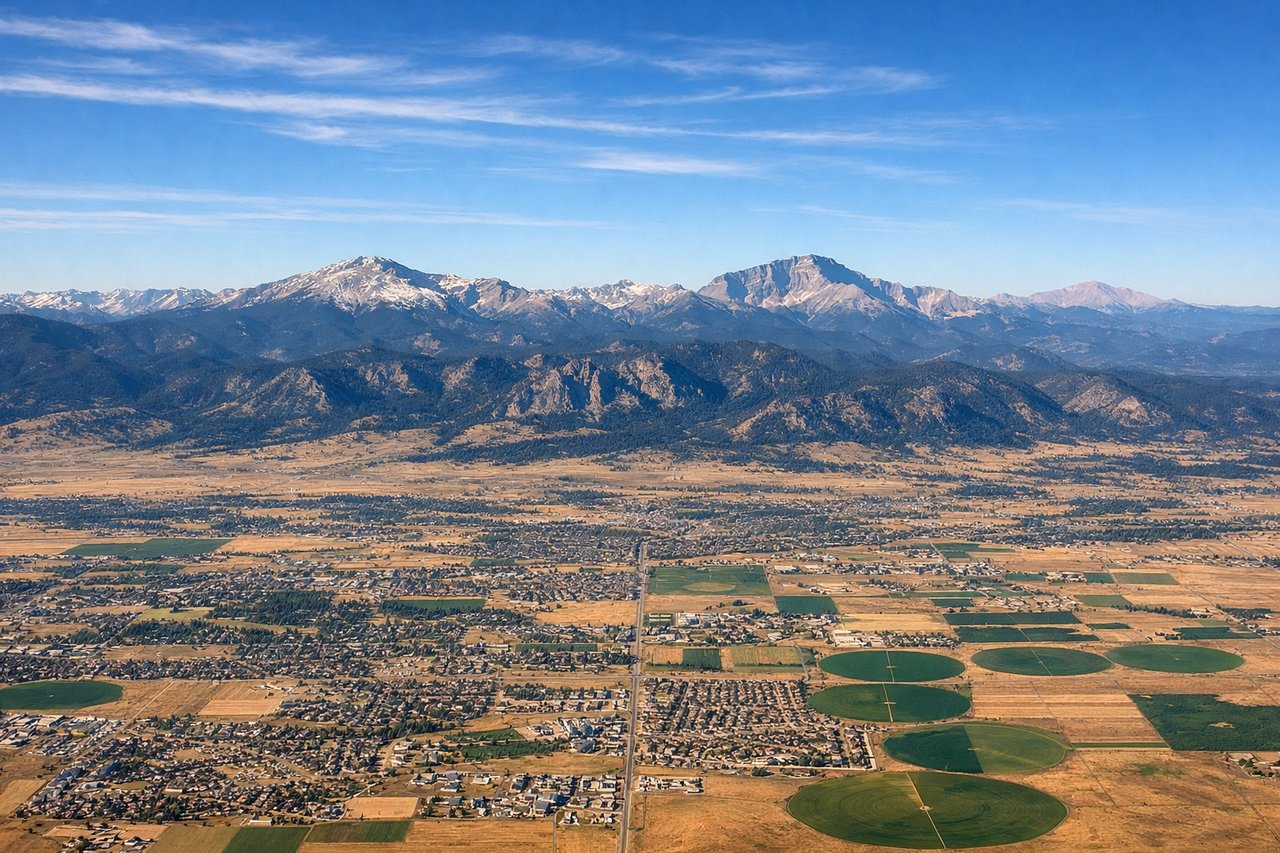
The flight crosses the high plains of southeastern Colorado and the Oklahoma Panhandle — largely flat, semi-arid grassland and agricultural patchwork. The Cimarron River valley becomes faintly visible as a shallow drainage cutting through the Oklahoma Panhandle. The terrain is uniformly flat with large center-pivot irrigation circles visible as green discs on the brown plains. No significant topographic features exist along the mid-route corridor.
Great circle distance and headings ›Phase by phase
Takeoff from DEN
LEFTDEN typically departs east or southeast on runways 16/17/25/26. A left-side seat on a southeast departure gives you a clear view back toward the Front Range of the Rocky Mountains, including Pikes Peak and the Denver metro sprawl. The contrast between the flat plains and the abrupt mountain wall is dramatic and immediately visible.
Landing at OKC
LEFTOKC typically lands from the east or northeast on runways 13/17/18. A left-side seat on approach from the northeast gives you a view over the Oklahoma City metro, the Oklahoma River, and Lake Hefner to the northwest. The city layout and the distinctive grid of the plains are clearly visible on descent.
Will your flight be in sunlight?
Pick a date and time in the Sun Map to watch the sun move across your whole flight.
About This Route
Which side of the plane should I sit on flying from Denver International (DEN) to Will Rogers World (OKC)?
Sit on the Left side of the plane for the best views on flights from Denver to Oklahoma City. Left side wins both ends of the flight. At takeoff you get the Rocky Mountain Front Range panorama, and at landing you get the Oklahoma City metro and Lake Hefner on approach. The right side offers flat plains throughout with no comparable landmarks.
What can I see during takeoff from Denver International in Denver?
During takeoff from Denver International (DEN), sit on the Left side for the best views. DEN typically departs east or southeast on runways 16/17/25/26. A left-side seat on a southeast departure gives you a clear view back toward the Front Range of the Rocky Mountains, including Pikes Peak and the Denver metro sprawl. The contrast between the flat plains and the abrupt mountain wall is dramatic and immediately visible. Notable sights include: Front Range Rocky Mountains, Pikes Peak (south), Denver metro grid, Cherry Creek Reservoir.
What can I see when landing at Will Rogers World in Oklahoma City?
When landing at Will Rogers World (OKC), sit on the Left side for the best views. OKC typically lands from the east or northeast on runways 13/17/18. A left-side seat on approach from the northeast gives you a view over the Oklahoma City metro, the Oklahoma River, and Lake Hefner to the northwest. The city layout and the distinctive grid of the plains are clearly visible on descent. Notable sights include: Oklahoma City downtown skyline, Lake Hefner, Oklahoma River, I-40/I-35 interchange.
How long is the flight from Denver to Oklahoma City?
The flight from Denver International (DEN) to Will Rogers World (OKC) takes about 1 hour 30 minutes. The shortest flight path between them is 495 miles (796 km); winds and air traffic control usually add a few percent.
What does the Denver to Oklahoma City flight path pass over?
The flight crosses the high plains of southeastern Colorado and the Oklahoma Panhandle — largely flat, semi-arid grassland and agricultural patchwork. The Cimarron River valley becomes faintly visible as a shallow drainage cutting through the Oklahoma Panhandle. The terrain is uniformly flat with large center-pivot irrigation circles visible as green discs on the brown plains. No significant topographic features exist along the mid-route corridor.