Right side scores higher due to superior scenic content on both takeoff and landing. Departure offers the Caspian Sea and Baku's coastal infrastructure; arrival delivers the dramatic Phang Nga Bay karsts and Andaman Sea approach—one of Southeast Asia's most visually distinctive landing sequences. Left side is dominated by flat terrain and open ocean with minimal landmark density.
Flown GYD to HKT? Did we get it right?
Flight Path
Baku to Phuket is 3,706 miles (5,964 km), a flight of about 7 hours 15 minutes.
The flight path crosses the Persian Gulf (visible during early cruise), then traverses the Arabian Sea and Indian Ocean for approximately 5 hours of open water. The Strait of Hormuz and Gulf of Oman are visible during the first 90 minutes of cruise. The Arabian Peninsula's eastern coast (Oman) passes to the left during early-to-mid cruise. The Maldives archipelago may be visible as a scattered chain of small islands during mid-cruise if the flight path passes nearby. The Indian subcontinent's southern tip (Kerala coast) is typically too far north to see. The final 2 hours approach Thailand's Andaman coast, with the Andaman Sea becoming increasingly visible as the aircraft descends toward Phuket.
Great circle distance and headings ›Phase by phase
Takeoff from GYD
RIGHTRight side captures the Caspian Sea coastline and Absheron Peninsula immediately after departure. Baku's harbor and oil infrastructure are visible during climb-out, with the Caspian extending to the horizon. Left side faces inland toward the flat Absheron steppe with minimal visual interest.
Landing at HKT
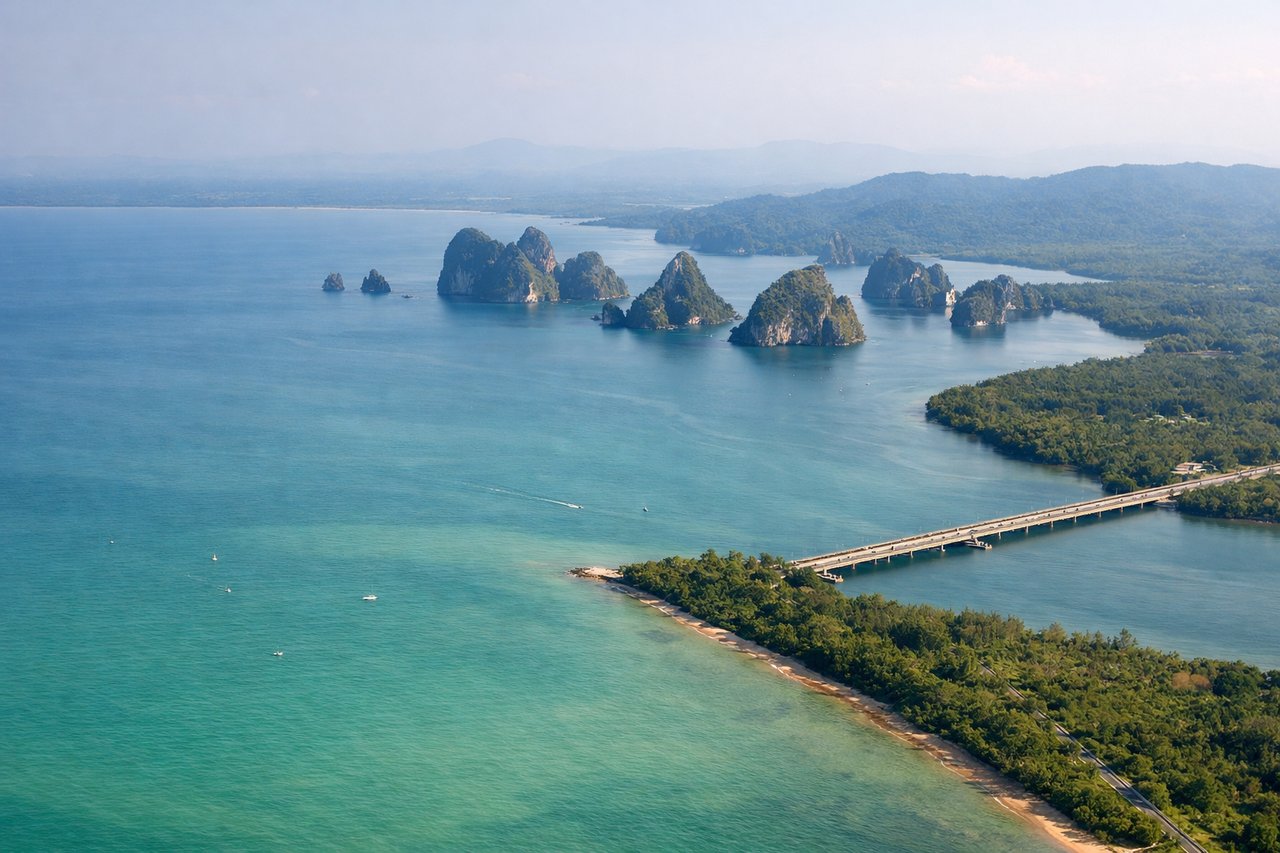
RIGHTRight side offers the most dramatic approach into Phuket. Depending on runway 27 usage (westbound landing), the aircraft descends over the Andaman Sea with Mai Khao Beach visible below, then crosses Phang Nga Bay's limestone karsts and mangrove forests. Left side sees only open ocean and distant coastline during the final descent.
Will your flight be in sunlight?
Pick a date and time in the Sun Map to watch the sun move across your whole flight.
About This Route
Which side of the plane should I sit on flying from Heydar Aliyev International Airport (GYD) to Phuket International (HKT)?
Sit on the Right side of the plane for the best views on flights from Baku to Phuket. Right side scores higher due to superior scenic content on both takeoff and landing. Departure offers the Caspian Sea and Baku's coastal infrastructure; arrival delivers the dramatic Phang Nga Bay karsts and Andaman Sea approach—one of Southeast Asia's most visually distinctive landing sequences. Left side is dominated by flat terrain and open ocean with minimal landmark density.
What can I see during takeoff from Heydar Aliyev International Airport in Baku?
During takeoff from Heydar Aliyev International Airport (GYD), sit on the Right side for the best views. Right side captures the Caspian Sea coastline and Absheron Peninsula immediately after departure. Baku's harbor and oil infrastructure are visible during climb-out, with the Caspian extending to the horizon. Left side faces inland toward the flat Absheron steppe with minimal visual interest. Notable sights include: Caspian Sea, Baku harbor and city skyline, Absheron Peninsula coastline, oil platforms dotting the shallow waters.
What can I see when landing at Phuket International in Phuket?
When landing at Phuket International (HKT), sit on the Right side for the best views. Right side offers the most dramatic approach into Phuket. Depending on runway 27 usage (westbound landing), the aircraft descends over the Andaman Sea with Mai Khao Beach visible below, then crosses Phang Nga Bay's limestone karsts and mangrove forests. Left side sees only open ocean and distant coastline during the final descent. Notable sights include: Andaman Sea, Mai Khao Beach, Phang Nga Bay limestone karsts, mangrove forests and coastal wetlands.
How long is the flight from Baku to Phuket?
The flight from Heydar Aliyev International Airport (GYD) to Phuket International (HKT) takes about 7 hours 15 minutes. The shortest flight path between them is 3,706 miles (5,964 km); winds and air traffic control usually add a few percent.
What does the Baku to Phuket flight path pass over?
The flight path crosses the Persian Gulf (visible during early cruise), then traverses the Arabian Sea and Indian Ocean for approximately 5 hours of open water. The Strait of Hormuz and Gulf of Oman are visible during the first 90 minutes of cruise. The Arabian Peninsula's eastern coast (Oman) passes to the left during early-to-mid cruise. The Maldives archipelago may be visible as a scattered chain of small islands during mid-cruise if the flight path passes nearby. The Indian subcontinent's southern tip (Kerala coast) is typically too far north to see. The final 2 hours approach Thailand's Andaman coast, with the Andaman Sea becoming increasingly visible as the aircraft descends toward Phuket.