Hong Kong to Chengdu is 839 miles (1,350 km), a flight of about 2 hours 15 minutes.
Right seats capture the dramatic departure over Hong Kong's water and urban landscape, then maintain advantage during the long cruise over southern China's terrain transitions, and finally offer the best view of Chengdu's approach over the Chengdu Plain with the Longquan Mountains as a geographic marker.
Flight Path
The flight path crosses from Hong Kong northwestward over Guangdong Province's agricultural plains and low hills, then transitions into the Yangtze River valley region. Around the midpoint, the terrain becomes noticeably more elevated as the aircraft approaches the eastern edge of the Sichuan Basin. The Wuling Mountains and related ranges form a distant backdrop to the east and northeast during cruise. The landscape transitions from coastal/subtropical to inland continental, with visibility of major river valleys (particularly the Yangtze system) and increasing elevation as the aircraft approaches Chengdu's higher altitude (1,925 feet). No single dramatic landmark dominates the cruise phase, but the gradual terrain rise and shift from water-abundant Guangdong to the drier Sichuan Basin is geographically significant.
Great circle distance and headings ›
.jpg?width=600)

Phase by phase
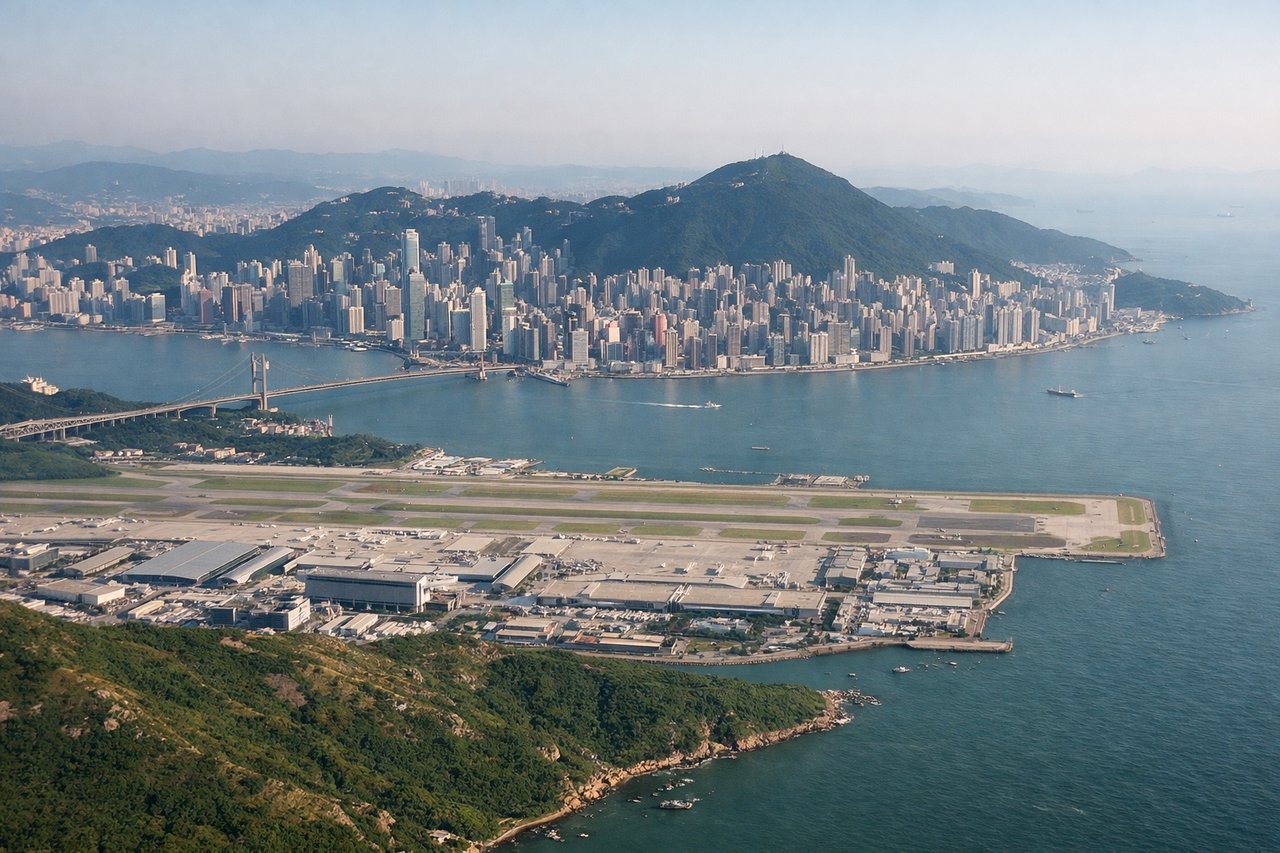
Takeoff from HKG
LEFTHKG typically departs runway 07L/R heading northwest. Left seats face toward the New Territories and the approach path over Victoria Harbour, giving clear views of Kowloon's urban sprawl and the surrounding water before climbing inland.
Landing at CTU
RIGHTCTU (Shuangliu) has runways oriented roughly 01/19. Approach from the south means descent over the Chengdu Plain with right seats positioned to see the Longquan Mountains to the east and the city's eastern sprawl. The terrain transition from flat agricultural plain to urban development is more dramatic on the right side.
Landmarks on this routeAll landmarks →
Will your flight be in sunlight?
Pick a date and time in the Sun Map to watch the sun move across your whole flight.
About This Route
Which side of the plane should I sit on flying from Hong Kong International (HKG) to Shuangliu (CTU)?
Sit on the Right side of the plane for the best views on flights from Hong Kong to Chengdu. Right seats capture the dramatic departure over Hong Kong's water and urban landscape, then maintain advantage during the long cruise over southern China's terrain transitions, and finally offer the best view of Chengdu's approach over the Chengdu Plain with the Longquan Mountains as a geographic marker.
What can I see during takeoff from Hong Kong International in Hong Kong?
During takeoff from Hong Kong International (HKG), sit on the Left side for the best views. HKG typically departs runway 07L/R heading northwest. Left seats face toward the New Territories and the approach path over Victoria Harbour, giving clear views of Kowloon's urban sprawl and the surrounding water before climbing inland. Notable sights include: Victoria Harbour (immediate foreground), Kowloon Peninsula (left/north), New Territories hills (receding north), Hong Kong Island's northern shore (right/south).
What can I see when landing at Shuangliu in Chengdu?
When landing at Shuangliu (CTU), sit on the Right side for the best views. CTU (Shuangliu) has runways oriented roughly 01/19. Approach from the south means descent over the Chengdu Plain with right seats positioned to see the Longquan Mountains to the east and the city's eastern sprawl. The terrain transition from flat agricultural plain to urban development is more dramatic on the right side. Notable sights include: Chengdu city (sprawling urban grid below), Longquan Mountains (right/east, low range), Chengdu Plain agricultural fields (foreground/left, patchwork pattern), Minjiang River (threading through plain, visible as linear feature).
How long is the flight from Hong Kong to Chengdu?
The flight from Hong Kong International (HKG) to Shuangliu (CTU) takes about 2 hours 15 minutes. The shortest flight path between them is 839 miles (1,350 km); winds and air traffic control usually add a few percent.
What does the Hong Kong to Chengdu flight path pass over?
The flight path crosses from Hong Kong northwestward over Guangdong Province's agricultural plains and low hills, then transitions into the Yangtze River valley region. Around the midpoint, the terrain becomes noticeably more elevated as the aircraft approaches the eastern edge of the Sichuan Basin. The Wuling Mountains and related ranges form a distant backdrop to the east and northeast during cruise. The landscape transitions from coastal/subtropical to inland continental, with visibility of major river valleys (particularly the Yangtze system) and increasing elevation as the aircraft approaches Chengdu's higher altitude (1,925 feet). No single dramatic landmark dominates the cruise phase, but the gradual terrain rise and shift from water-abundant Guangdong to the drier Sichuan Basin is geographically significant.