While takeoff on the right offers Alpine views, the landing approach on the left provides more sustained and dramatic scenery—the Danube River and its valley are genuinely spectacular from altitude and occupy a longer portion of the descent. The Danube's meanders and the contrast between river, forest, and basin create more visually distinctive features than the gradual Alpine rise visible on departure.
Flown LIN to VIE? Did we get it right?
Flight Path
Milan to Vienna is 391 miles (629 km), a flight of about 1 hour 15 minutes.
The flight path crosses the Austrian Alps, passing over or near the Salzkammergut lake district (visible as a series of small alpine lakes nestled in forested valleys), the Enns River valley, and the transition zone between the high Alps and the Danube lowlands. The Salzkammergut lakes—particularly Hallstatt and Traunsee—are genuinely visible at cruise altitude as bright blue water bodies surrounded by steep forested slopes. The terrain gradually descends from 6,000-8,000 foot Alpine passes toward the 1,000-foot Danube valley.
Great circle distance and headings ›


Phase by phase
Takeoff from LIN
RIGHTRight side offers views of the Alps immediately after climb-out from Milan. The aircraft departs northeast, and the right wing faces the pre-Alpine foothills and early Alpine ridges that rise dramatically within 20-30 miles of the airport.
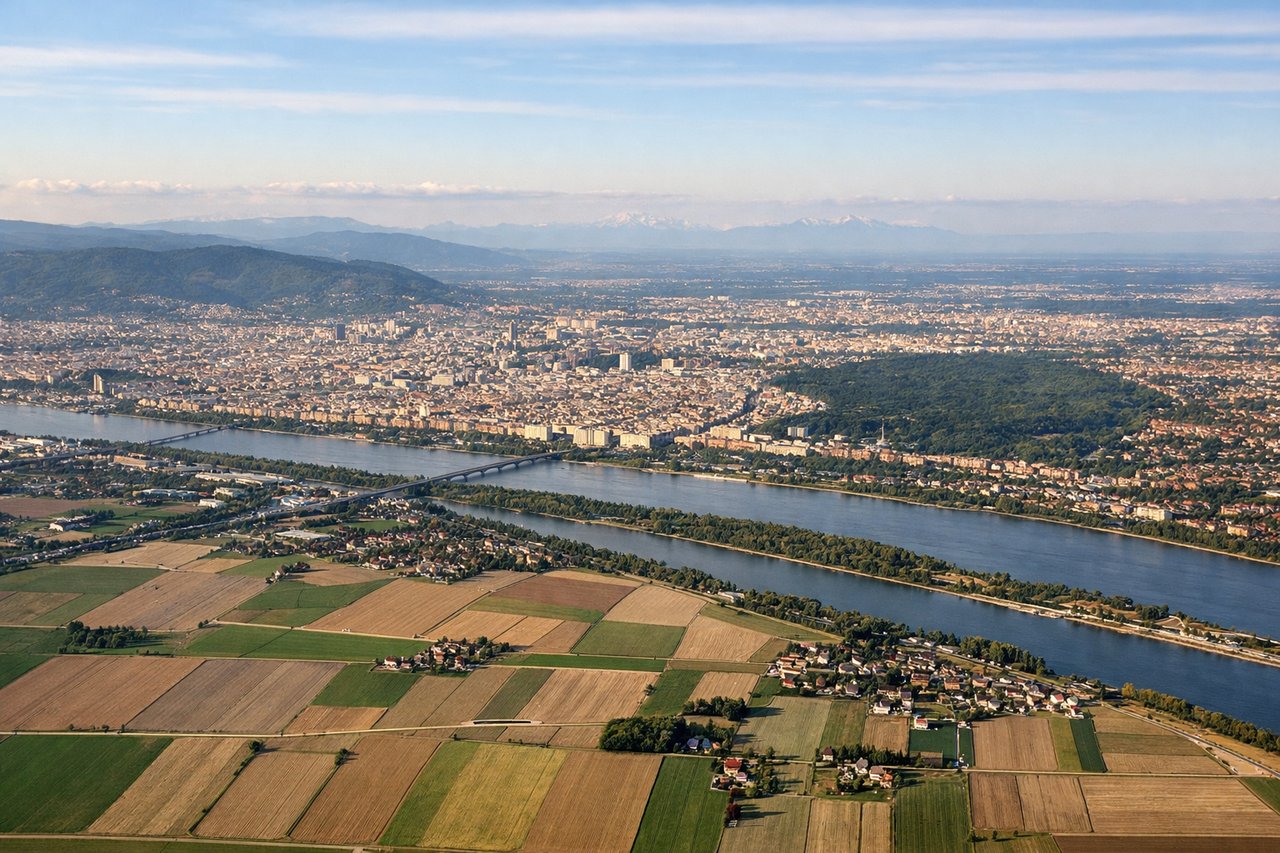
Landing at VIE
LEFTLeft side provides excellent views during descent into Vienna. The aircraft approaches from the southwest, and the left wing faces the Danube River valley and the eastern Alpine foothills. The Danube's distinctive meanders and the flat Vienna Basin become prominent in the final descent phase.
Will your flight be in sunlight?
Pick a date and time in the Sun Map to watch the sun move across your whole flight.
About This Route
Which side of the plane should I sit on flying from Linate (LIN) to Schwechat (VIE)?
Sit on the Left side of the plane for the best views on flights from Milan to Vienna. While takeoff on the right offers Alpine views, the landing approach on the left provides more sustained and dramatic scenery—the Danube River and its valley are genuinely spectacular from altitude and occupy a longer portion of the descent. The Danube's meanders and the contrast between river, forest, and basin create more visually distinctive features than the gradual Alpine rise visible on departure.
What can I see during takeoff from Linate in Milan?
During takeoff from Linate (LIN), sit on the Right side for the best views. Right side offers views of the Alps immediately after climb-out from Milan. The aircraft departs northeast, and the right wing faces the pre-Alpine foothills and early Alpine ridges that rise dramatically within 20-30 miles of the airport. Notable sights include: Pre-Alpine foothills south of Lake Como, early ridges of the Bergamasque Alps, Lake Como (visible as a long narrow body of water to the north), Po River valley stretching west toward Turin.
What can I see when landing at Schwechat in Vienna?
When landing at Schwechat (VIE), sit on the Left side for the best views. Left side provides excellent views during descent into Vienna. The aircraft approaches from the southwest, and the left wing faces the Danube River valley and the eastern Alpine foothills. The Danube's distinctive meanders and the flat Vienna Basin become prominent in the final descent phase. Notable sights include: Danube River with its characteristic meanders and oxbow lakes, Vienna Basin (flat agricultural plain), eastern Alpine foothills (Wienerwald), Danube floodplain forests appearing as dark green patches.
How long is the flight from Milan to Vienna?
The flight from Linate (LIN) to Schwechat (VIE) takes about 1 hour 15 minutes. The shortest flight path between them is 391 miles (629 km); winds and air traffic control usually add a few percent.
What does the Milan to Vienna flight path pass over?
The flight path crosses the Austrian Alps, passing over or near the Salzkammergut lake district (visible as a series of small alpine lakes nestled in forested valleys), the Enns River valley, and the transition zone between the high Alps and the Danube lowlands. The Salzkammergut lakes—particularly Hallstatt and Traunsee—are genuinely visible at cruise altitude as bright blue water bodies surrounded by steep forested slopes. The terrain gradually descends from 6,000-8,000 foot Alpine passes toward the 1,000-foot Danube valley.