Bucharest to Dubai is 2,109 miles (3,394 km), a flight of about 4 hours 45 minutes.
The left side delivers the best views at both ends of the flight — Bucharest's urban layout on departure and Dubai Creek plus the Gulf on approach. Across the cruise portion, the left side also faces generally north, which over Turkey and the Caucasus region offers slightly better mountain views, though at 35,000 feet most terrain appears as distant texture.
Flight Path
The flight tracks southeast from Romania across the Black Sea, then over northeastern Turkey and the Anatolian plateau, crossing into Georgia or Armenia airspace before descending over Iran and the Persian Gulf. Notable features include the Black Sea crossing visible as open water, the Caucasus Mountains appearing as a distant ridgeline from cruising altitude, the Iranian plateau's arid brown terrain, and the Persian Gulf's distinctive shallow turquoise waters on descent into Dubai.
Great circle distance and headings ›
.jpg?width=600)
_and_the_Dubai_skyline_(25781049892).jpg?width=600)
Phase by phase
Takeoff from OTP
LEFTOTP's primary departure runway 08R sends aircraft eastward, then turning southeast toward the Black Sea. The left side faces north toward Bucharest city center and the Vlăsia plain, while the right side looks south over flat agricultural land. However, on the more common southward departures from runway 26L heading west then banking southeast, the left side captures Bucharest's urban sprawl and the Dâmbovița River corridor clearly.
Landing at DXB
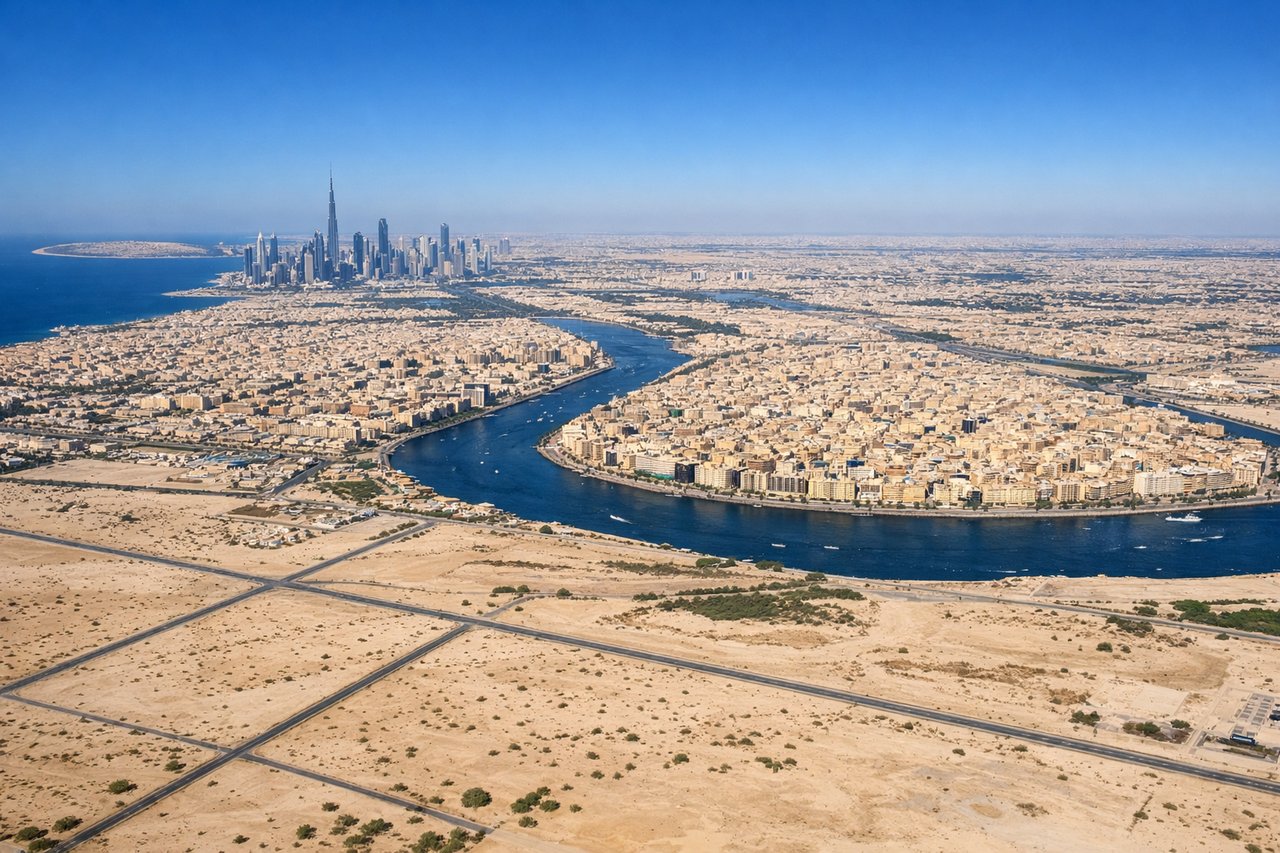
LEFTDXB's primary landing runways 12L/12R bring aircraft in from the northwest over the desert, tracking southeast toward the coast. The left side faces northeast and captures Dubai Creek, Deira, and the older city districts, while the right side looks southwest over inland desert. On the 30L/30R configuration departing northwest, the left side still captures the coastline and Palm Jumeirah.
Landmarks on this routeAll landmarks →
Will your flight be in sunlight?
Pick a date and time in the Sun Map to watch the sun move across your whole flight.
About This Route
Which side of the plane should I sit on flying from Otopeni (OTP) to Dubai International (DXB)?
Sit on the Left side of the plane for the best views on flights from Bucharest to Dubai. The left side delivers the best views at both ends of the flight — Bucharest's urban layout on departure and Dubai Creek plus the Gulf on approach. Across the cruise portion, the left side also faces generally north, which over Turkey and the Caucasus region offers slightly better mountain views, though at 35,000 feet most terrain appears as distant texture.
What can I see during takeoff from Otopeni in Bucharest?
During takeoff from Otopeni (OTP), sit on the Left side for the best views. OTP's primary departure runway 08R sends aircraft eastward, then turning southeast toward the Black Sea. The left side faces north toward Bucharest city center and the Vlăsia plain, while the right side looks south over flat agricultural land. However, on the more common southward departures from runway 26L heading west then banking southeast, the left side captures Bucharest's urban sprawl and the Dâmbovița River corridor clearly. Notable sights include: Bucharest city center and Herăstrău Park lake complex, Dâmbovița River winding southwest, the flat Wallachian Plain stretching to the horizon, Snagov Lake to the north.
What can I see when landing at Dubai International in Dubai?
When landing at Dubai International (DXB), sit on the Left side for the best views. DXB's primary landing runways 12L/12R bring aircraft in from the northwest over the desert, tracking southeast toward the coast. The left side faces northeast and captures Dubai Creek, Deira, and the older city districts, while the right side looks southwest over inland desert. On the 30L/30R configuration departing northwest, the left side still captures the coastline and Palm Jumeirah. Notable sights include: Dubai Creek and Deira district, Dubai International Airport's parallel runways visible below, the Arabian Gulf coastline and shallow turquoise waters, the downtown Dubai skyline including Burj Khalifa visible to the southwest.
How long is the flight from Bucharest to Dubai?
The flight from Otopeni (OTP) to Dubai International (DXB) takes about 4 hours 45 minutes. The shortest flight path between them is 2,109 miles (3,394 km); winds and air traffic control usually add a few percent.
What does the Bucharest to Dubai flight path pass over?
The flight tracks southeast from Romania across the Black Sea, then over northeastern Turkey and the Anatolian plateau, crossing into Georgia or Armenia airspace before descending over Iran and the Persian Gulf. Notable features include the Black Sea crossing visible as open water, the Caucasus Mountains appearing as a distant ridgeline from cruising altitude, the Iranian plateau's arid brown terrain, and the Persian Gulf's distinctive shallow turquoise waters on descent into Dubai.