Marrakech to Cedar City is 5,641 miles (9,078 km), a flight of about 11 hours.
While takeoff favors left for the Atlas Mountains, the landing approach provides more sustained and visually distinctive scenery. The Markagunt Plateau and red rock formations are geologically unique and dominate the approach corridor, making right seats the better overall choice for this transatlantic route.
Flight Path
This route crosses the Atlantic Ocean for roughly 6-7 hours with minimal landmarks. The flight path passes south of the Azores (if visible at cruise altitude around 35,000 feet, they appear as tiny specks on the horizon). Over the Atlantic, expect only open ocean and occasional cloud formations. As the aircraft approaches North America, Newfoundland and the Canadian Maritimes may be visible on the left side during descent. The flight then crosses the northeastern United States and gradually transitions to the arid interior West. The Rocky Mountains and Colorado Plateau become visible during the final 2-3 hours of descent, with the Great Basin's characteristic basin-and-range topography appearing as the aircraft approaches Utah.
Great circle distance and headings ›


Phase by phase
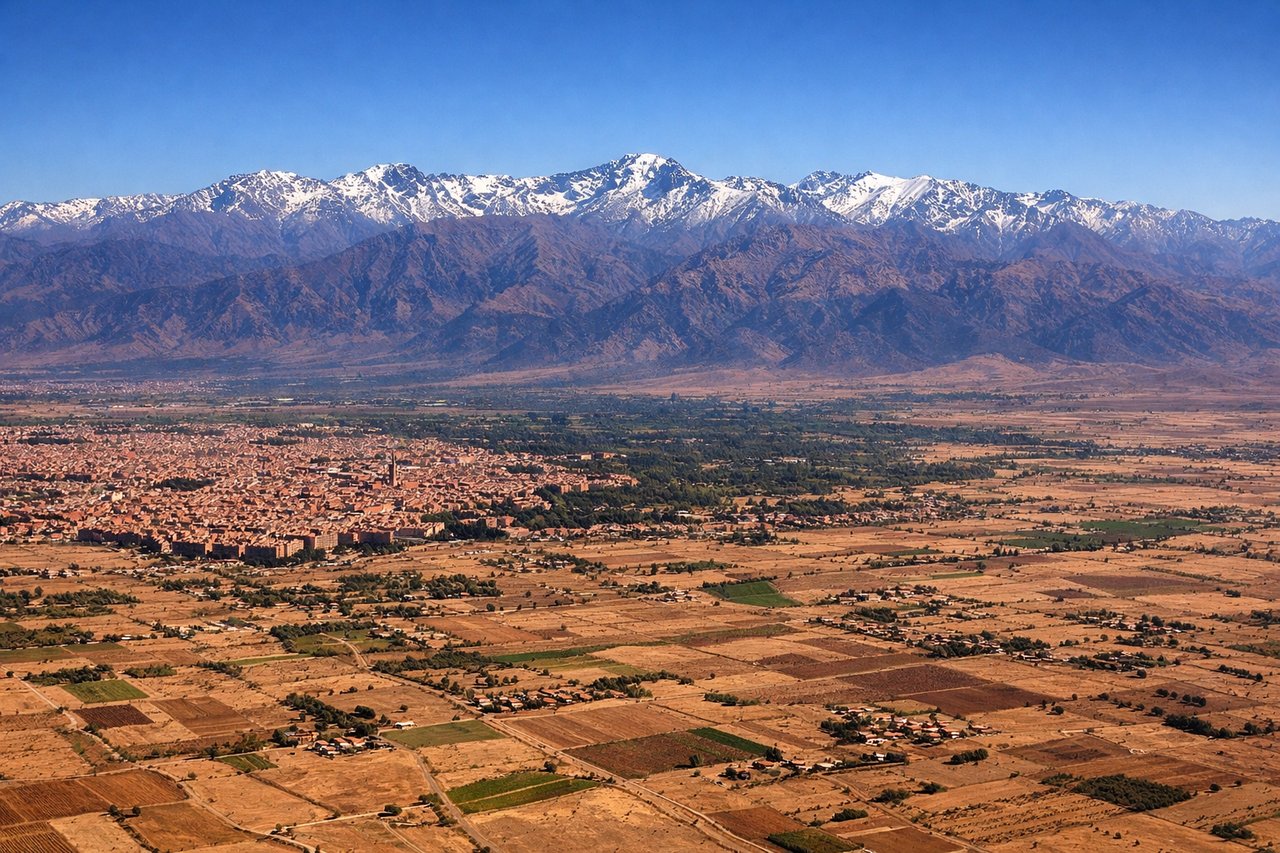
Takeoff from RAK
LEFTRAK typically departs runway 09 (westbound) or 27 (eastbound). Left seats on a westbound departure offer views of the High Atlas Mountains rising immediately south of the airport. The Atlas range is dramatic and snow-capped in winter, providing the strongest visual during initial climb.
Landing at CDC
RIGHTCedar City Regional typically uses runway 18 (southbound) for landing. Right-side seats on approach from the north provide unobstructed views of the Markagunt Plateau and the red rock formations of the Dixie National Forest. These distinctive rust-colored cliffs and mesas are visually striking and unique to this region.
Landmarks on this routeAll landmarks →
Will your flight be in sunlight?
Pick a date and time in the Sun Map to watch the sun move across your whole flight.
About This Route
Which side of the plane should I sit on flying from Menara (RAK) to Cedar City Rgnl (CDC)?
Sit on the Right side of the plane for the best views on flights from Marrakech to Cedar City. While takeoff favors left for the Atlas Mountains, the landing approach provides more sustained and visually distinctive scenery. The Markagunt Plateau and red rock formations are geologically unique and dominate the approach corridor, making right seats the better overall choice for this transatlantic route.
What can I see during takeoff from Menara in Marrakech?
During takeoff from Menara (RAK), sit on the Left side for the best views. RAK typically departs runway 09 (westbound) or 27 (eastbound). Left seats on a westbound departure offer views of the High Atlas Mountains rising immediately south of the airport. The Atlas range is dramatic and snow-capped in winter, providing the strongest visual during initial climb. Notable sights include: High Atlas Mountains (south), Marrakech medina and Koutoubia Mosque (north), Haouz plain (immediate vicinity), Anti-Atlas foothills (distant southeast).
What can I see when landing at Cedar City Rgnl in Cedar City?
When landing at Cedar City Rgnl (CDC), sit on the Right side for the best views. Cedar City Regional typically uses runway 18 (southbound) for landing. Right-side seats on approach from the north provide unobstructed views of the Markagunt Plateau and the red rock formations of the Dixie National Forest. These distinctive rust-colored cliffs and mesas are visually striking and unique to this region. Notable sights include: Markagunt Plateau (dominant), Dixie National Forest red cliffs (southeast), Cedar City town grid (immediate), Hurricane Cliffs (north).
How long is the flight from Marrakech to Cedar City?
The flight from Menara (RAK) to Cedar City Rgnl (CDC) takes about 11 hours. The shortest flight path between them is 5,641 miles (9,078 km); winds and air traffic control usually add a few percent.
What does the Marrakech to Cedar City flight path pass over?
This route crosses the Atlantic Ocean for roughly 6-7 hours with minimal landmarks. The flight path passes south of the Azores (if visible at cruise altitude around 35,000 feet, they appear as tiny specks on the horizon). Over the Atlantic, expect only open ocean and occasional cloud formations. As the aircraft approaches North America, Newfoundland and the Canadian Maritimes may be visible on the left side during descent. The flight then crosses the northeastern United States and gradually transitions to the arid interior West. The Rocky Mountains and Colorado Plateau become visible during the final 2-3 hours of descent, with the Great Basin's characteristic basin-and-range topography appearing as the aircraft approaches Utah.