Moscow to Tashkent is 1,751 miles (2,818 km), a flight of about 3 hours 15 minutes.
While takeoff favors the right for Moscow city views, the landing approach provides more sustained and dramatic scenery—the contrast between irrigated green fields and desert, plus the Tian Shan foothills—makes left-side seats the better overall choice for this route.
Flight Path
The flight path crosses the flat Russian steppe southward, passing east of the Volga River region, then enters Kazakhstan's steppe landscape. Around the midpoint (near Aktobe or Atyrau region), the terrain remains uniformly flat grassland with occasional settlements and sparse vegetation. As the aircraft approaches Uzbekistan, the landscape transitions to irrigated river valleys and the Aral Sea region (now largely desiccated). The final approach descends into the Fergana Valley's northern edge, where the Chirchik River system supports intensive agriculture. The Tian Shan mountain range remains visible as a distant southern backdrop throughout the descent into Tashkent.
Great circle distance and headings ›

Phase by phase
Takeoff from SVO
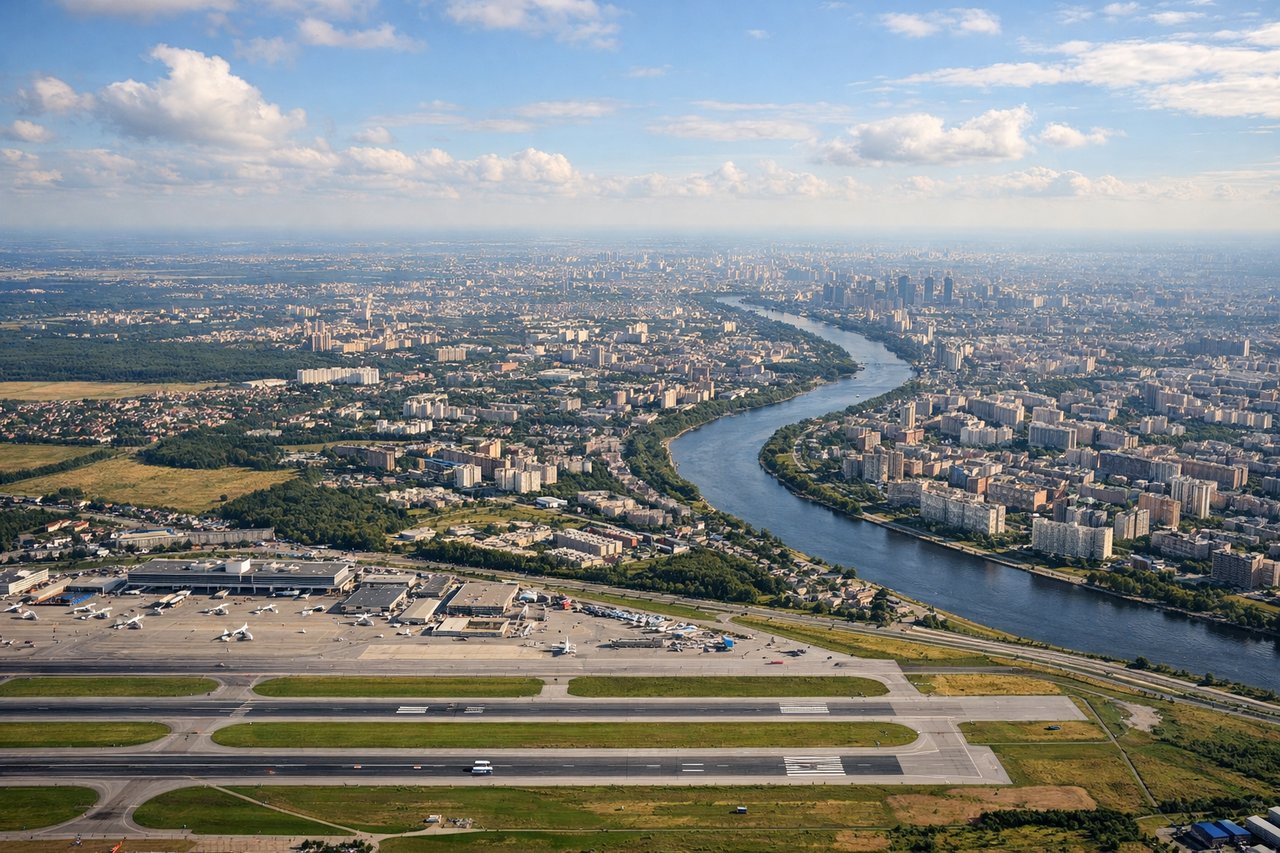
RIGHTRight-side seats capture the Moscow River's serpentine path through the city and the urban sprawl of central Moscow during northwesterly departures. Sheremetyevo typically departs runways 24L/R or 06L/R; northwesterly departures (24L/R) offer the best city views before climbing into cloud layers.
Landing at TAS
LEFTLeft-side seats provide views of the Tashkent urban area and the Chirchik River valley during descent. Tashkent's Yuzhny airport typically uses runways 10L/R or 28L/R; southeasterly approaches (10L/R) align left seats with the city and surrounding irrigated agricultural plains.
Landmarks on this routeAll landmarks →
Will your flight be in sunlight?
Pick a date and time in the Sun Map to watch the sun move across your whole flight.
About This Route
Which side of the plane should I sit on flying from Sheremetyevo (SVO) to Tashkent International Airport (TAS)?
Sit on the Left side of the plane for the best views on flights from Moscow to Tashkent. While takeoff favors the right for Moscow city views, the landing approach provides more sustained and dramatic scenery—the contrast between irrigated green fields and desert, plus the Tian Shan foothills—makes left-side seats the better overall choice for this route.
What can I see during takeoff from Sheremetyevo in Moscow?
During takeoff from Sheremetyevo (SVO), sit on the Right side for the best views. Right-side seats capture the Moscow River's serpentine path through the city and the urban sprawl of central Moscow during northwesterly departures. Sheremetyevo typically departs runways 24L/R or 06L/R; northwesterly departures (24L/R) offer the best city views before climbing into cloud layers. Notable sights include: Moscow River winding through city center, Kremlin district (small but identifiable as dense urban core), concentric ring roads radiating outward, suburban sprawl extending to tree-covered plains.
What can I see when landing at Tashkent International Airport in Tashkent?
When landing at Tashkent International Airport (TAS), sit on the Left side for the best views. Left-side seats provide views of the Tashkent urban area and the Chirchik River valley during descent. Tashkent's Yuzhny airport typically uses runways 10L/R or 28L/R; southeasterly approaches (10L/R) align left seats with the city and surrounding irrigated agricultural plains. Notable sights include: Tashkent city sprawl (identifiable as dense urban grid), Chirchik River and irrigation canals (bright linear features in arid landscape), Tian Shan foothills (distant southern horizon), cultivated green fields contrasting with desert.
How long is the flight from Moscow to Tashkent?
The flight from Sheremetyevo (SVO) to Tashkent International Airport (TAS) takes about 3 hours 15 minutes. The shortest flight path between them is 1,751 miles (2,818 km); winds and air traffic control usually add a few percent.
What does the Moscow to Tashkent flight path pass over?
The flight path crosses the flat Russian steppe southward, passing east of the Volga River region, then enters Kazakhstan's steppe landscape. Around the midpoint (near Aktobe or Atyrau region), the terrain remains uniformly flat grassland with occasional settlements and sparse vegetation. As the aircraft approaches Uzbekistan, the landscape transitions to irrigated river valleys and the Aral Sea region (now largely desiccated). The final approach descends into the Fergana Valley's northern edge, where the Chirchik River system supports intensive agriculture. The Tian Shan mountain range remains visible as a distant southern backdrop throughout the descent into Tashkent.