While left seats win the takeoff, right seats dominate the landing approach with superior views of Nadi Bay's reef patterns and Viti Levu's volcanic interior. The landing experience is more visually rewarding and geographically distinctive than the takeoff.
Flight Path
The flight path crosses the Tasman Sea heading northeast. At cruise altitude (around 33,000 feet), you'll pass over open ocean with no significant landmarks. The route tracks roughly 055-060 magnetic heading. Approximately 90 minutes into flight, you'll approach Fiji's island group; the first landfall is typically the southern islands of the Fiji archipelago (Kadavu or nearby smaller islands) appearing as small dark specks on the horizon before the larger mass of Viti Levu becomes visible. The approach to Nadi descends over the Yasawa Islands to the north before turning toward Nadi Bay.
Great circle distance and headings ›.jpg?width=600)

Phase by phase

Takeoff from SYD
LEFTSYD typically departs runways 07L/07R (eastbound) or 25L/25R (westbound). Eastbound departures favor left seats for views of the Blue Mountains rising inland to the west as you climb. Westbound departures favor left seats for Sydney Harbour and the coastal escarpment.
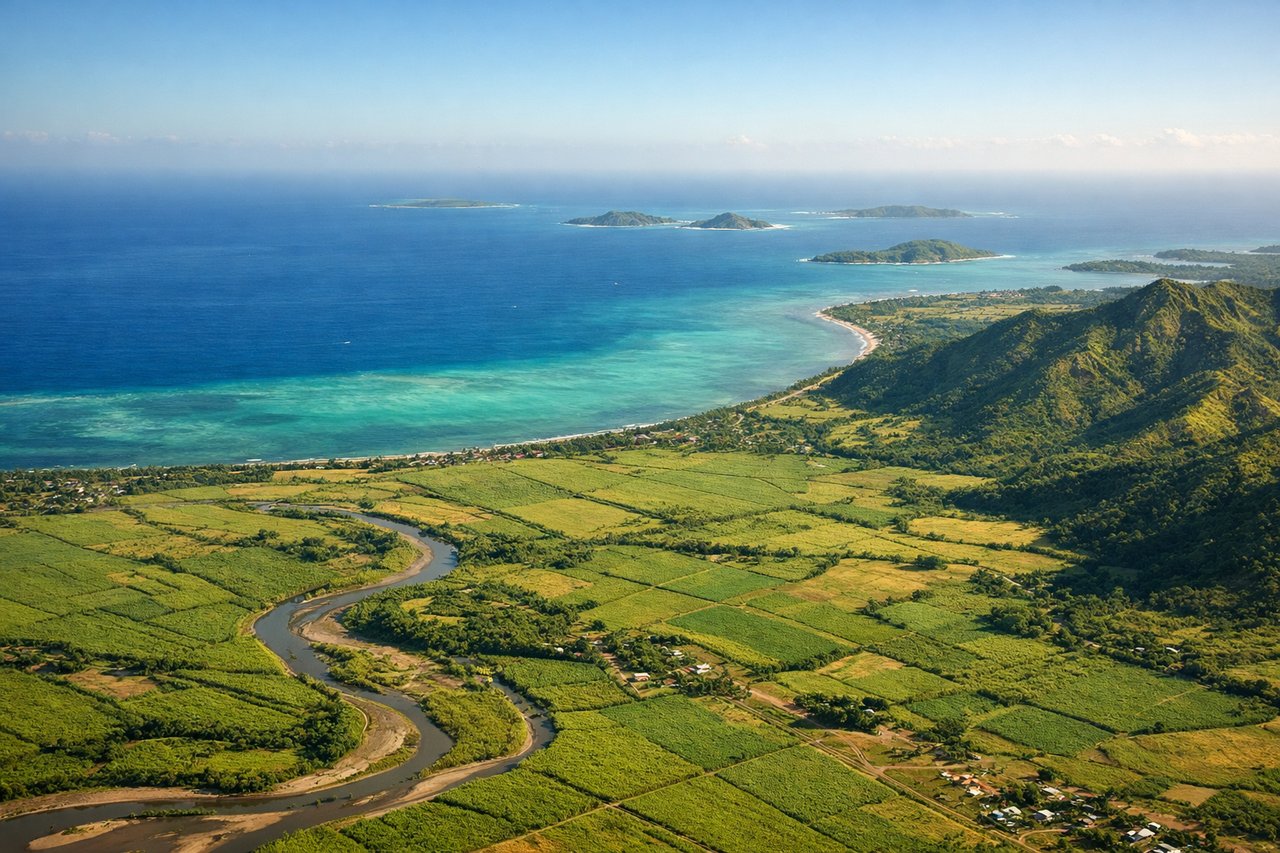
Landing at NAN
RIGHTNadi approaches typically use runways 02 or 20 depending on wind. Right-side seats offer superior views of Viti Levu's interior highlands and the approach over Nadi Bay. You'll see the distinctive volcanic terrain and reef patterns as you descend toward the runway.
Landmarks on this routeAll landmarks →
Will your flight be in sunlight?
See exactly which side of the plane gets sun and shade at your departure time.
About This Route
Which side of the plane should I sit on flying from Kingsford Smith International Airport (SYD) to Nadi International (NAN)?
Sit on the Right side of the plane for the best views on flights from Sydney to Nandi. While left seats win the takeoff, right seats dominate the landing approach with superior views of Nadi Bay's reef patterns and Viti Levu's volcanic interior. The landing experience is more visually rewarding and geographically distinctive than the takeoff.
What can I see during takeoff from Kingsford Smith International Airport in Sydney?
During takeoff from Kingsford Smith International Airport (SYD), sit on the Left side for the best views. SYD typically departs runways 07L/07R (eastbound) or 25L/25R (westbound). Eastbound departures favor left seats for views of the Blue Mountains rising inland to the west as you climb. Westbound departures favor left seats for Sydney Harbour and the coastal escarpment. Notable sights include: Blue Mountains (inland, western horizon during eastbound climb), Sydney Harbour and headlands (visible during initial westbound climb), Tasman Sea (eastern approach), Illawarra Escarpment (southern coastal ridge).
What can I see when landing at Nadi International in Nandi?
When landing at Nadi International (NAN), sit on the Right side for the best views. Nadi approaches typically use runways 02 or 20 depending on wind. Right-side seats offer superior views of Viti Levu's interior highlands and the approach over Nadi Bay. You'll see the distinctive volcanic terrain and reef patterns as you descend toward the runway. Notable sights include: Nadi Bay (turquoise lagoon with visible reef patterns), Viti Levu interior highlands (volcanic ridges), Yasawa Islands chain (northern horizon), coral reef boundaries (sharp color contrast in shallow water).
How long is the flight from Sydney to Nandi?
The flight from Kingsford Smith International Airport (SYD) to Nadi International (NAN) takes Approximately 3 hours 15 minutes.
What does the Sydney to Nandi flight path pass over?
The flight path crosses the Tasman Sea heading northeast. At cruise altitude (around 33,000 feet), you'll pass over open ocean with no significant landmarks. The route tracks roughly 055-060 magnetic heading. Approximately 90 minutes into flight, you'll approach Fiji's island group; the first landfall is typically the southern islands of the Fiji archipelago (Kadavu or nearby smaller islands) appearing as small dark specks on the horizon before the larger mass of Viti Levu becomes visible. The approach to Nadi descends over the Yasawa Islands to the north before turning toward Nadi Bay.