While takeoff offers archipelago drama on the right, the landing approach provides more sustained and spectacular views of Ecuador's iconic Andean volcanoes and the dramatic geography surrounding Quito. The left side captures the flight's most geographically significant moment.
Flight Path
The flight crosses the Pacific westward from Galápagos, then turns east toward the South American continent. You'll pass over open ocean for roughly 90 minutes before the Ecuadorian coast becomes visible. The western slopes of the Andes begin appearing around 45 minutes before landing, with the inter-Andean valley and volcanic peaks becoming increasingly prominent. Cotopaxi and Pichincha dominate the final 30 minutes of descent into Quito's high-altitude basin (9,350 ft elevation).
Great circle distance and headings ›

Phase by phase
Takeoff from GPS
RIGHTGPS typically departs to the west or northwest. Right-side seats capture the dramatic volcanic terrain of Isabela Island and the broader Galápagos archipelago as you climb out over the Pacific. The left side faces open ocean with minimal visual interest.
Landing at UIO
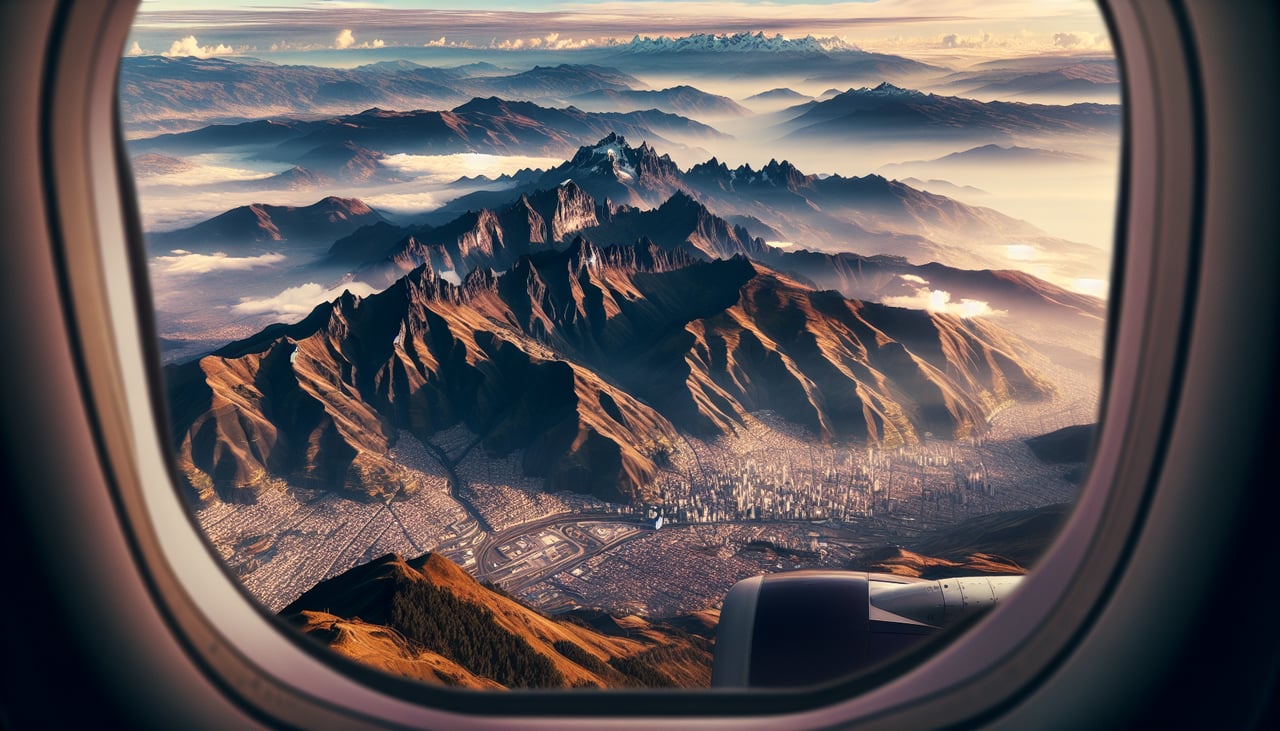
LEFTUIO typically lands on runways oriented north-south (01/19). Left-side seats on approach from the west provide excellent views of the Andes cordillera, particularly the snow-capped peaks surrounding Quito's high-altitude basin. Right side faces the city itself but with less dramatic topography.
Landmarks on this routeAll landmarks →
Will your flight be in sunlight?
See exactly which side of the plane gets sun and shade at your departure time.
About This Route
Which side of the plane should I sit on flying from Seymour (GPS) to Mariscal Sucre International Airport (UIO)?
Sit on the Left side of the plane for the best views on flights from Galapagos to Quito. While takeoff offers archipelago drama on the right, the landing approach provides more sustained and spectacular views of Ecuador's iconic Andean volcanoes and the dramatic geography surrounding Quito. The left side captures the flight's most geographically significant moment.
What can I see during takeoff from Seymour in Galapagos?
During takeoff from Seymour (GPS), sit on the Right side for the best views. GPS typically departs to the west or northwest. Right-side seats capture the dramatic volcanic terrain of Isabela Island and the broader Galápagos archipelago as you climb out over the Pacific. The left side faces open ocean with minimal visual interest. Notable sights include: Isabela Island (distinctive seahorse shape), Fernandina Island to the northwest, Sierra Negra volcano crater, Pacific Ocean horizon.
What can I see when landing at Mariscal Sucre International Airport in Quito?
When landing at Mariscal Sucre International Airport (UIO), sit on the Left side for the best views. UIO typically lands on runways oriented north-south (01/19). Left-side seats on approach from the west provide excellent views of the Andes cordillera, particularly the snow-capped peaks surrounding Quito's high-altitude basin. Right side faces the city itself but with less dramatic topography. Notable sights include: Cotopaxi volcano (snow-capped, 19,347 ft), Pichincha volcanic complex (flanking Quito), Quito's urban sprawl in the inter-Andean valley, Eastern Cordillera ridge line.
How long is the flight from Galapagos to Quito?
The flight from Seymour (GPS) to Mariscal Sucre International Airport (UIO) takes Approximately 2 hours 15 minutes.
What does the Galapagos to Quito flight path pass over?
The flight crosses the Pacific westward from Galápagos, then turns east toward the South American continent. You'll pass over open ocean for roughly 90 minutes before the Ecuadorian coast becomes visible. The western slopes of the Andes begin appearing around 45 minutes before landing, with the inter-Andean valley and volcanic peaks becoming increasingly prominent. Cotopaxi and Pichincha dominate the final 30 minutes of descent into Quito's high-altitude basin (9,350 ft elevation).