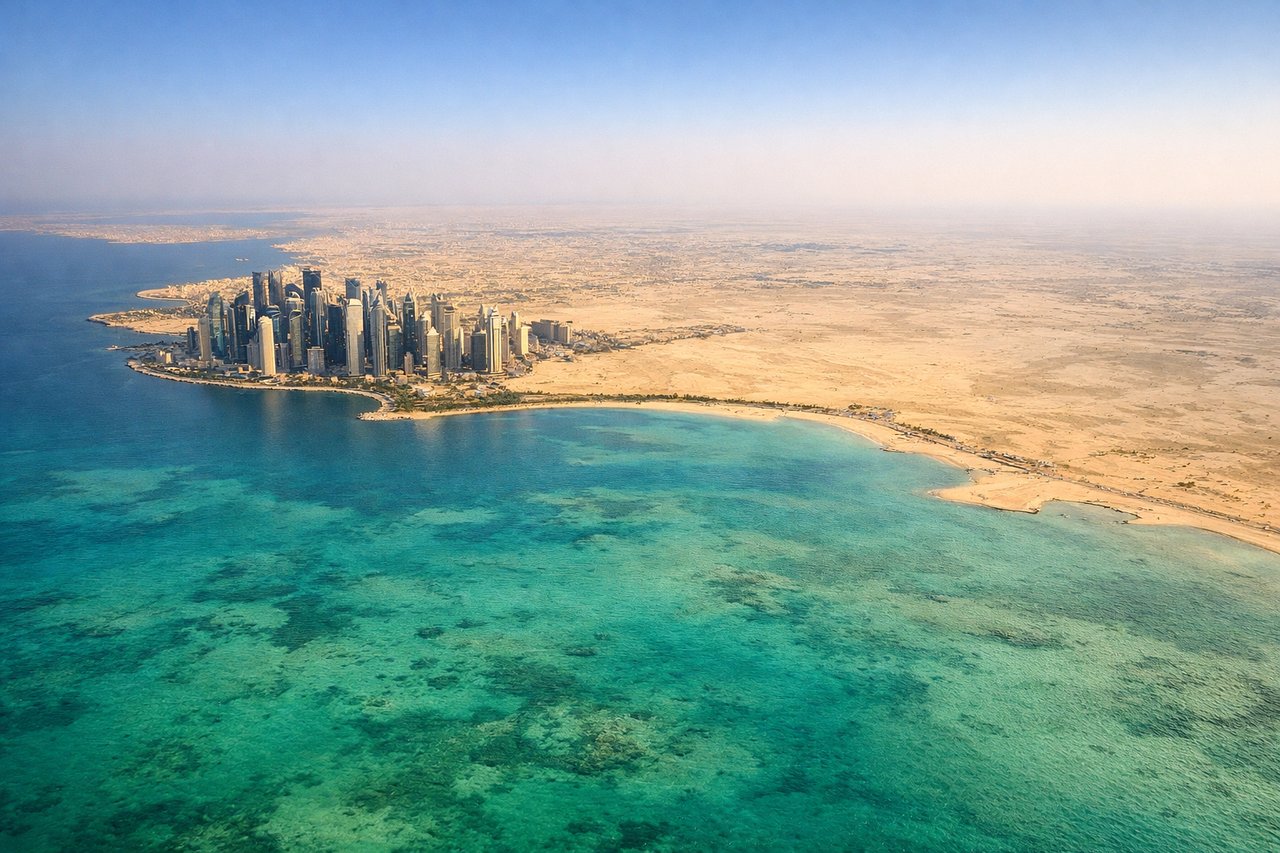
While takeoff favors the right for Kigali's highlands and Lake Kivu, the landing approach into Doha strongly favors left seats for views of the Persian Gulf, the corniche, and Doha's skyline—the most visually distinctive part of this route. The landing experience outweighs the takeoff advantage.
Flight Path
The flight path crosses central Africa (South Sudan, northern Uganda, or southern Ethiopia depending on routing), then transitions over the Red Sea region and Arabian Peninsula. Notable midpoint features include the Nile River valley (if routed through Sudan), the Red Sea's narrow water body with its distinctive coral reef systems visible at altitude, and the Arabian Peninsula's vast sand deserts (Rub' al Khali visible on the right/east side during the Arabian crossing). The transition from equatorial green highlands to arid desert is dramatic and occurs roughly 2.5–3 hours into the flight.
Great circle distance and headings ›


Phase by phase
Takeoff from KGL
RIGHTKigali typically departs runway 06 (northeast) or 24 (southwest). Right-side seats on a northeast departure offer views of the Rwandan highlands and Lake Kivu's northern reaches. Southwest departures favor left seats, but northeast is more common for northbound traffic to Doha.
Landing at DOH
LEFTDoha typically lands runway 16L/16R (northbound) or 34L/34R (southbound). A northbound approach (runway 16) gives left-side views of the Persian Gulf's western coastline, Doha's waterfront development, and the Qatar peninsula's distinctive geography. This is the more common approach vector from the southwest.
Landmarks on this routeAll landmarks →
Will your flight be in sunlight?
See exactly which side of the plane gets sun and shade at your departure time.
About This Route
Which side of the plane should I sit on flying from Kigali International (KGL) to Hamad International Airport (DOH)?
Sit on the Left side of the plane for the best views on flights from Kigali to Doha. While takeoff favors the right for Kigali's highlands and Lake Kivu, the landing approach into Doha strongly favors left seats for views of the Persian Gulf, the corniche, and Doha's skyline—the most visually distinctive part of this route. The landing experience outweighs the takeoff advantage.
What can I see during takeoff from Kigali International in Kigali?
During takeoff from Kigali International (KGL), sit on the Right side for the best views. Kigali typically departs runway 06 (northeast) or 24 (southwest). Right-side seats on a northeast departure offer views of the Rwandan highlands and Lake Kivu's northern reaches. Southwest departures favor left seats, but northeast is more common for northbound traffic to Doha. Notable sights include: Lake Kivu (western shoreline), Virunga Mountains (northern horizon, volcanic peaks), Kigali city grid (directly below during initial climb), Rwanda's rolling highland terrain.
What can I see when landing at Hamad International Airport in Doha?
When landing at Hamad International Airport (DOH), sit on the Left side for the best views. Doha typically lands runway 16L/16R (northbound) or 34L/34R (southbound). A northbound approach (runway 16) gives left-side views of the Persian Gulf's western coastline, Doha's waterfront development, and the Qatar peninsula's distinctive geography. This is the more common approach vector from the southwest. Notable sights include: Persian Gulf (eastern water body), Doha's corniche and high-rise district (downtown skyline), Qatar peninsula's flat coastal terrain, artificial islands and port facilities.
How long is the flight from Kigali to Doha?
The flight from Kigali International (KGL) to Hamad International Airport (DOH) takes Approximately 5 hours 45 minutes to 6 hours 15 minutes.
What does the Kigali to Doha flight path pass over?
The flight path crosses central Africa (South Sudan, northern Uganda, or southern Ethiopia depending on routing), then transitions over the Red Sea region and Arabian Peninsula. Notable midpoint features include the Nile River valley (if routed through Sudan), the Red Sea's narrow water body with its distinctive coral reef systems visible at altitude, and the Arabian Peninsula's vast sand deserts (Rub' al Khali visible on the right/east side during the Arabian crossing). The transition from equatorial green highlands to arid desert is dramatic and occurs roughly 2.5–3 hours into the flight.