Reno to Seoul is 5,662 miles (9,113 km), a flight of about 11 hours 30 minutes.
The takeoff view of the Sierra Nevada and Lake Tahoe is more dramatic and geographically distinctive than the landing approach. While the Han River and Seoul approach are interesting, they're partially obscured by haze and urban density. The Sierra escarpment on departure is a world-class alpine view.
Flight Path
The flight path crosses the North Pacific, passing north of Hawaii (not visible—too far south of track). Notable midpoint geography includes the Aleutian Islands chain (far north, typically not visible from cruise altitude on this routing), and the transition from Pacific open ocean to the continental shelf approaching East Asia. The route crosses the International Date Line around 6-7 hours into flight. As you approach East Asia, you'll pass over or near the Japanese archipelago (Hokkaido visible on clear days, 8-9 hours into flight), then the Korean Peninsula becomes visible 10-11 hours in. The Yellow Sea crossing on final descent offers views of China's Shandong Peninsula to the south.
Great circle distance and headings ›


Phase by phase
Takeoff from RNO
LEFTRNO typically departs runway 16L/34R (north-south) or 16R/34L. Left seats on northbound departures capture the Sierra Nevada escarpment rising dramatically to the west. Southbound departures favor right seats, but northbound is more common for Pacific crossings. Left side gives you the eastern face of the range as you climb.
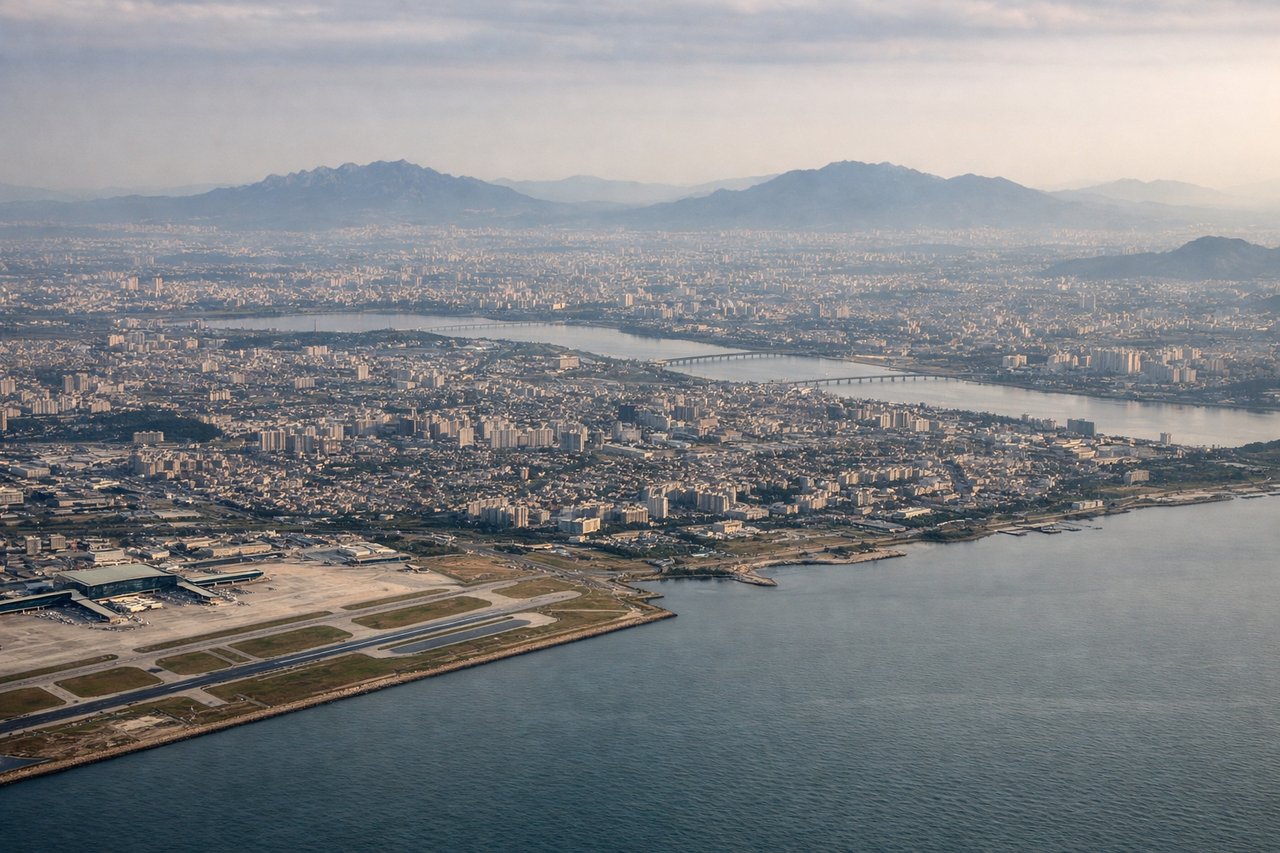
Landing at ICN
RIGHTIncheon International uses runways 03L/21R and 03R/21L (east-west oriented). Approaches from the Pacific typically arrive from the west on runway 03L or 03R. Right-side seats on westbound final approach capture Seoul's urban sprawl, the Han River, and Incheon's industrial waterfront as you descend over the Yellow Sea coastal plain.
Landmarks on this routeAll landmarks →
Will your flight be in sunlight?
Pick a date and time in the Sun Map to watch the sun move across your whole flight.
About This Route
Which side of the plane should I sit on flying from Reno Tahoe International (RNO) to Incheon International (ICN)?
Sit on the Left side of the plane for the best views on flights from Reno to Seoul. The takeoff view of the Sierra Nevada and Lake Tahoe is more dramatic and geographically distinctive than the landing approach. While the Han River and Seoul approach are interesting, they're partially obscured by haze and urban density. The Sierra escarpment on departure is a world-class alpine view.
What can I see during takeoff from Reno Tahoe International in Reno?
During takeoff from Reno Tahoe International (RNO), sit on the Left side for the best views. RNO typically departs runway 16L/34R (north-south) or 16R/34L. Left seats on northbound departures capture the Sierra Nevada escarpment rising dramatically to the west. Southbound departures favor right seats, but northbound is more common for Pacific crossings. Left side gives you the eastern face of the range as you climb. Notable sights include: Sierra Nevada (western escarpment), Lake Tahoe (south-southwest, visible as deep blue alpine lake), Washoe Valley (immediate foreground, sagebrush basin), Carson Range (closer western ridge).
What can I see when landing at Incheon International in Seoul?
When landing at Incheon International (ICN), sit on the Right side for the best views. Incheon International uses runways 03L/21R and 03R/21L (east-west oriented). Approaches from the Pacific typically arrive from the west on runway 03L or 03R. Right-side seats on westbound final approach capture Seoul's urban sprawl, the Han River, and Incheon's industrial waterfront as you descend over the Yellow Sea coastal plain. Notable sights include: Han River (major waterway threading through Seoul), Seoul metropolitan area (dense urban grid), Incheon port and industrial zone (immediate approach area), Yellow Sea (visible beyond airport to the west).
How long is the flight from Reno to Seoul?
The flight from Reno Tahoe International (RNO) to Incheon International (ICN) takes about 11 hours 30 minutes. The shortest flight path between them is 5,662 miles (9,113 km); winds and air traffic control usually add a few percent.
What does the Reno to Seoul flight path pass over?
The flight path crosses the North Pacific, passing north of Hawaii (not visible—too far south of track). Notable midpoint geography includes the Aleutian Islands chain (far north, typically not visible from cruise altitude on this routing), and the transition from Pacific open ocean to the continental shelf approaching East Asia. The route crosses the International Date Line around 6-7 hours into flight. As you approach East Asia, you'll pass over or near the Japanese archipelago (Hokkaido visible on clear days, 8-9 hours into flight), then the Korean Peninsula becomes visible 10-11 hours in. The Yellow Sea crossing on final descent offers views of China's Shandong Peninsula to the south.