Beauvais to Stockholm is 943 miles (1,517 km), a flight of about 2 hours 15 minutes.
While takeoff offers good views on the right, the landing approach on the left provides superior visual interest: Lake Mälaren and Stockholm's archipelago are far more distinctive than the Beauvais departure zone. The archipelago's complex island patterns and the contrast between forest and water make the approach the highlight of this route.
Flight Path
The flight path crosses the North European Plain, passing over the Benelux region and northern Germany. Notable features include: the Rhine-Meuse delta region (if routed south of direct), the North German Plain with its characteristic lakes and moraines, and the transition into Scandinavian terrain around southern Sweden. At cruise altitude (31,000-35,000 feet), individual landmarks become small, but the broad pattern of European geography—agricultural lowlands giving way to boreal forest—is visible. The Baltic Sea becomes apparent as a distinct water body in the final 30 minutes of flight.
Great circle distance and headings ›Phase by phase
Takeoff from BVA
RIGHTBeauvais typically departs eastward (runways 30/12). Right-side seats face north initially, offering views of the Seine valley and the Oise River system as you climb. Left seats see only inland farmland.
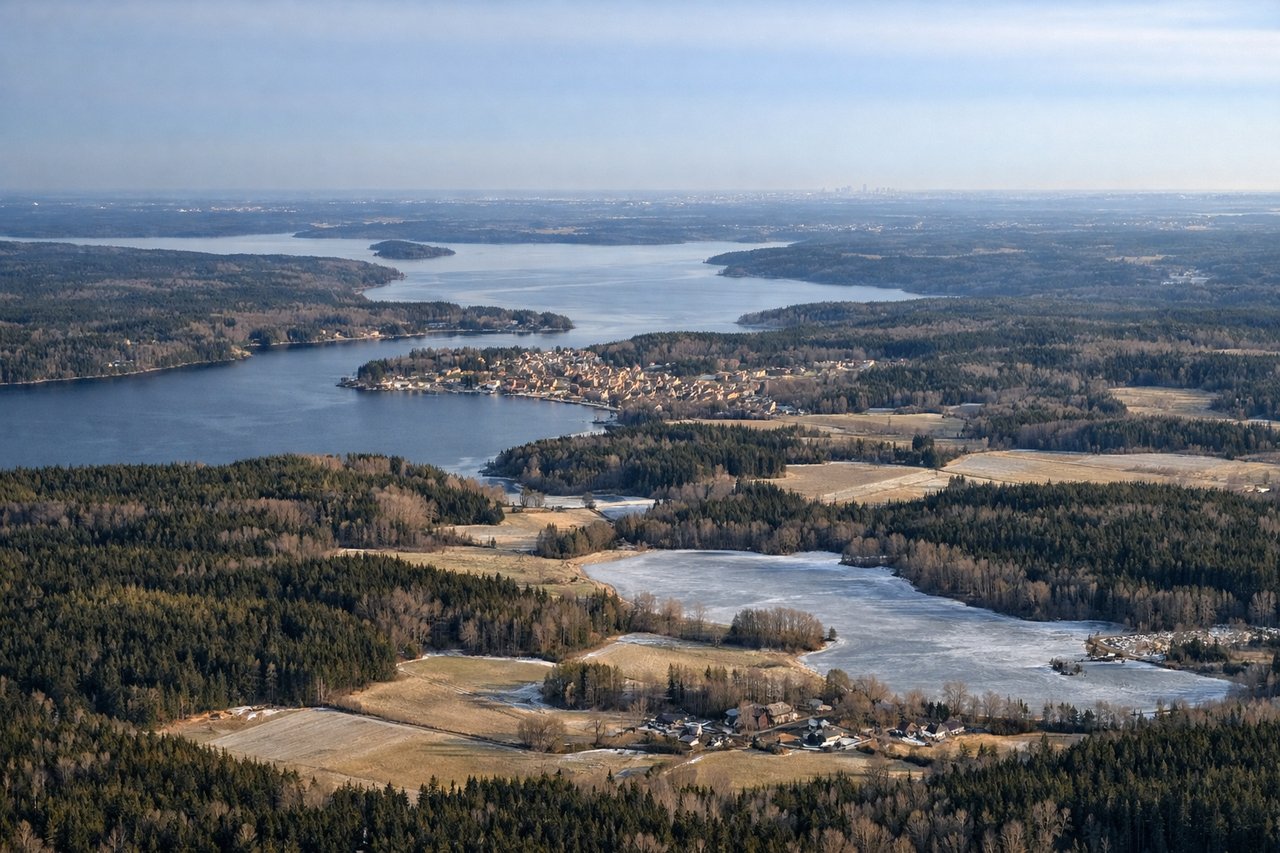
Landing at ARN
LEFTArlanda typically lands from the west (runways 26L/26R). Left-side seats during approach face north and northeast, providing views of Lake Mälaren's western arms and Stockholm's archipelago. Right seats see only inland forests.
Landmarks on this routeAll landmarks →
Will your flight be in sunlight?
Pick a date and time in the Sun Map to watch the sun move across your whole flight.
About This Route
Which side of the plane should I sit on flying from Tille (BVA) to Arlanda (ARN)?
Sit on the Left side of the plane for the best views on flights from Beauvais to Stockholm. While takeoff offers good views on the right, the landing approach on the left provides superior visual interest: Lake Mälaren and Stockholm's archipelago are far more distinctive than the Beauvais departure zone. The archipelago's complex island patterns and the contrast between forest and water make the approach the highlight of this route.
What can I see during takeoff from Tille in Beauvais?
During takeoff from Tille (BVA), sit on the Right side for the best views. Beauvais typically departs eastward (runways 30/12). Right-side seats face north initially, offering views of the Seine valley and the Oise River system as you climb. Left seats see only inland farmland. Notable sights include: Oise River valley (distinctive meandering waterway below), Seine River system to the northeast, Île-de-France agricultural plains, distant Paris urban sprawl on the horizon to the south.
What can I see when landing at Arlanda in Stockholm?
When landing at Arlanda (ARN), sit on the Left side for the best views. Arlanda typically lands from the west (runways 26L/26R). Left-side seats during approach face north and northeast, providing views of Lake Mälaren's western arms and Stockholm's archipelago. Right seats see only inland forests. Notable sights include: Lake Mälaren (massive freshwater lake, visible as a broad blue expanse), Stockholm archipelago with its characteristic island chains, Vättern lake visible on the distant horizon to the southwest, Swedish boreal forest (dense coniferous coverage).
How long is the flight from Beauvais to Stockholm?
The flight from Tille (BVA) to Arlanda (ARN) takes about 2 hours 15 minutes. The shortest flight path between them is 943 miles (1,517 km); winds and air traffic control usually add a few percent.
What does the Beauvais to Stockholm flight path pass over?
The flight path crosses the North European Plain, passing over the Benelux region and northern Germany. Notable features include: the Rhine-Meuse delta region (if routed south of direct), the North German Plain with its characteristic lakes and moraines, and the transition into Scandinavian terrain around southern Sweden. At cruise altitude (31,000-35,000 feet), individual landmarks become small, but the broad pattern of European geography—agricultural lowlands giving way to boreal forest—is visible. The Baltic Sea becomes apparent as a distinct water body in the final 30 minutes of flight.