While CDG's westbound departure offers modest Seine valley scenery, CLE's approach into Lake Erie and Cleveland's waterfront provides more dramatic visual contrast and recognizable urban landmarks. The lake, river, and skyline combination creates greater variety and visual interest than the relatively flat Île-de-France farmland. The full flight favors the right side due to the superior landing sequence, which comprises roughly one-third of the passenger experience.
Flown CDG to CLE? Did we get it right?
Flight Path
Paris to Cleveland is 3,926 miles (6,318 km), a flight of about 7 hours 15 minutes.
Transatlantic crossing over the North Atlantic with no significant landmarks for approximately 5 hours; eastern Newfoundland coastline visible during descent into North American airspace; Great Lakes region including Lake Ontario and Lake Erie shorelines during final approach phase; Appalachian foothills visible during initial climb-out from CDG and during descent toward CLE, though at cruise altitude these appear as distant terrain variations rather than dramatic features
Great circle distance and headings ›Phase by phase
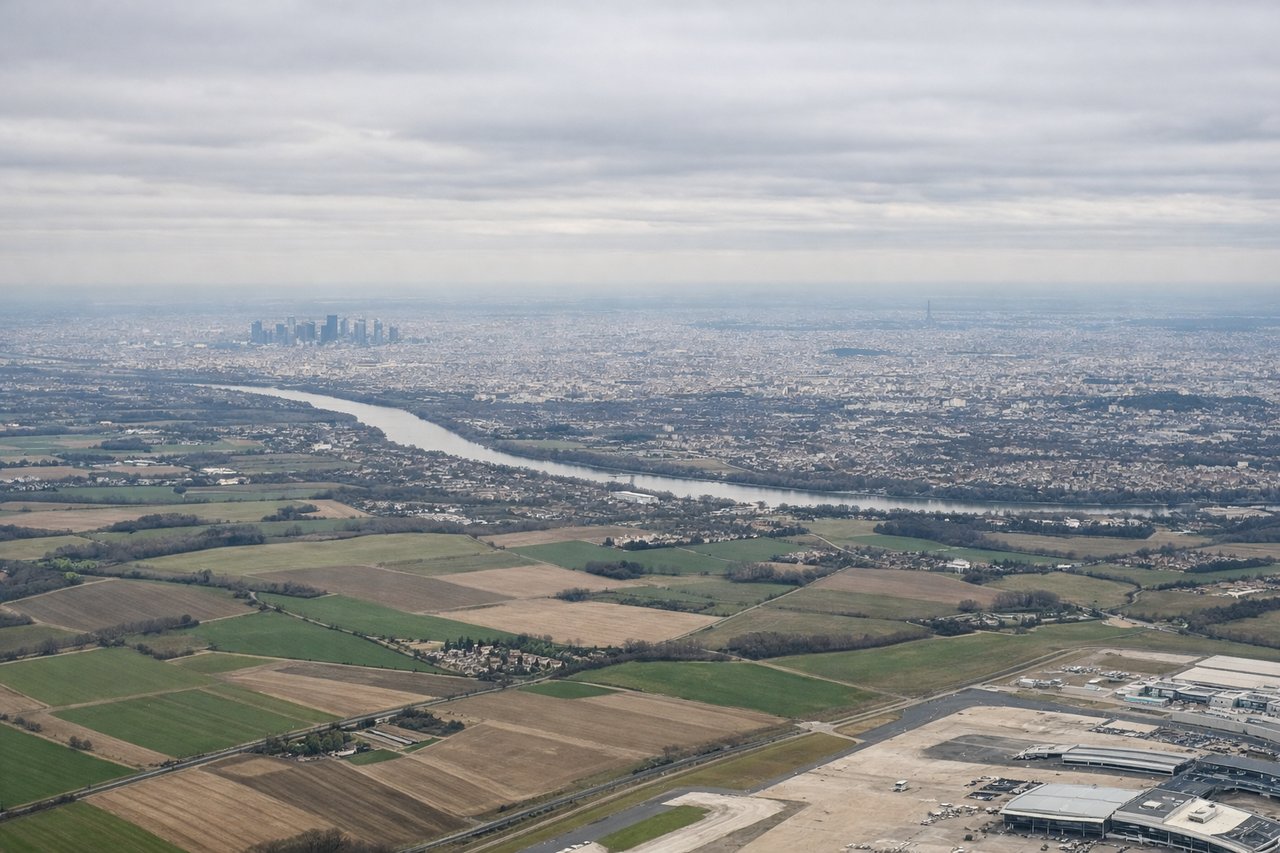
Takeoff from CDG
LEFTWestbound departures from CDG typically use runways 26R/26L, rotating west over the Seine valley and outer Paris suburbs. Left-side passengers see the Seine's meanders, Versailles region, and the gradual transition from urban sprawl to rural Île-de-France. Right side faces north toward Roissy industrial zones and flat northern suburbs—less visually distinctive.
Landing at CLE
RIGHTEastbound arrivals into CLE typically descend from the northeast and approach runways 24L/24R (southwest-facing). Right-side passengers see Lake Erie's southern shoreline, Cleveland's downtown skyline along the waterfront, the Cuyahoga River, and the industrial Flats district. Left side faces inland over flat Ohio farmland and suburbs—minimal visual interest.
Will your flight be in sunlight?
Pick a date and time in the Sun Map to watch the sun move across your whole flight.
About This Route
Which side of the plane should I sit on flying from Charles De Gaulle (CDG) to Cleveland Hopkins International (CLE)?
Sit on the Right side of the plane for the best views on flights from Paris to Cleveland. While CDG's westbound departure offers modest Seine valley scenery, CLE's approach into Lake Erie and Cleveland's waterfront provides more dramatic visual contrast and recognizable urban landmarks. The lake, river, and skyline combination creates greater variety and visual interest than the relatively flat Île-de-France farmland. The full flight favors the right side due to the superior landing sequence, which comprises roughly one-third of the passenger experience.
What can I see during takeoff from Charles De Gaulle in Paris?
During takeoff from Charles De Gaulle (CDG), sit on the Left side for the best views. Westbound departures from CDG typically use runways 26R/26L, rotating west over the Seine valley and outer Paris suburbs. Left-side passengers see the Seine's meanders, Versailles region, and the gradual transition from urban sprawl to rural Île-de-France. Right side faces north toward Roissy industrial zones and flat northern suburbs—less visually distinctive. Notable sights include: Seine River valley with visible meanders, Versailles Palace grounds (recognizable as formal gardens and palace complex), transition from Paris urban grid to rural farmland, occasional church spires and small towns dotting the landscape.
What can I see when landing at Cleveland Hopkins International in Cleveland?
When landing at Cleveland Hopkins International (CLE), sit on the Right side for the best views. Eastbound arrivals into CLE typically descend from the northeast and approach runways 24L/24R (southwest-facing). Right-side passengers see Lake Erie's southern shoreline, Cleveland's downtown skyline along the waterfront, the Cuyahoga River, and the industrial Flats district. Left side faces inland over flat Ohio farmland and suburbs—minimal visual interest. Notable sights include: Lake Erie's southern shore with visible wave patterns and water color variation, Cleveland downtown skyline with Terminal Tower and waterfront buildings, Cuyahoga River's distinctive bend through the Flats, Cleveland Browns Stadium and harbor area.
How long is the flight from Paris to Cleveland?
The flight from Charles De Gaulle (CDG) to Cleveland Hopkins International (CLE) takes about 7 hours 15 minutes. The shortest flight path between them is 3,926 miles (6,318 km); winds and air traffic control usually add a few percent.
What does the Paris to Cleveland flight path pass over?
Transatlantic crossing over the North Atlantic with no significant landmarks for approximately 5 hours; eastern Newfoundland coastline visible during descent into North American airspace; Great Lakes region including Lake Ontario and Lake Erie shorelines during final approach phase; Appalachian foothills visible during initial climb-out from CDG and during descent toward CLE, though at cruise altitude these appear as distant terrain variations rather than dramatic features