While takeoff favors left seats for mountain views, the landing approach over Victoria Harbour and Kowloon is more visually distinctive and memorable. Right seats capture Hong Kong's iconic urban-maritime geography during descent.
Flight Path
The flight path crosses the Coral Sea northwestward, passing east of the Great Barrier Reef (not visible at cruise altitude), then over the Sunda Strait region between Sumatra and Java. The Timor Sea and Arafura Sea are crossed at cruise altitude (typically 35,000 feet), where individual geographic features become indistinct. The South China Sea crossing offers minimal distinctive landmarks at altitude—mostly open water until approaching the Hong Kong approaches.
Great circle distance and headings ›.jpg?width=600)

Phase by phase
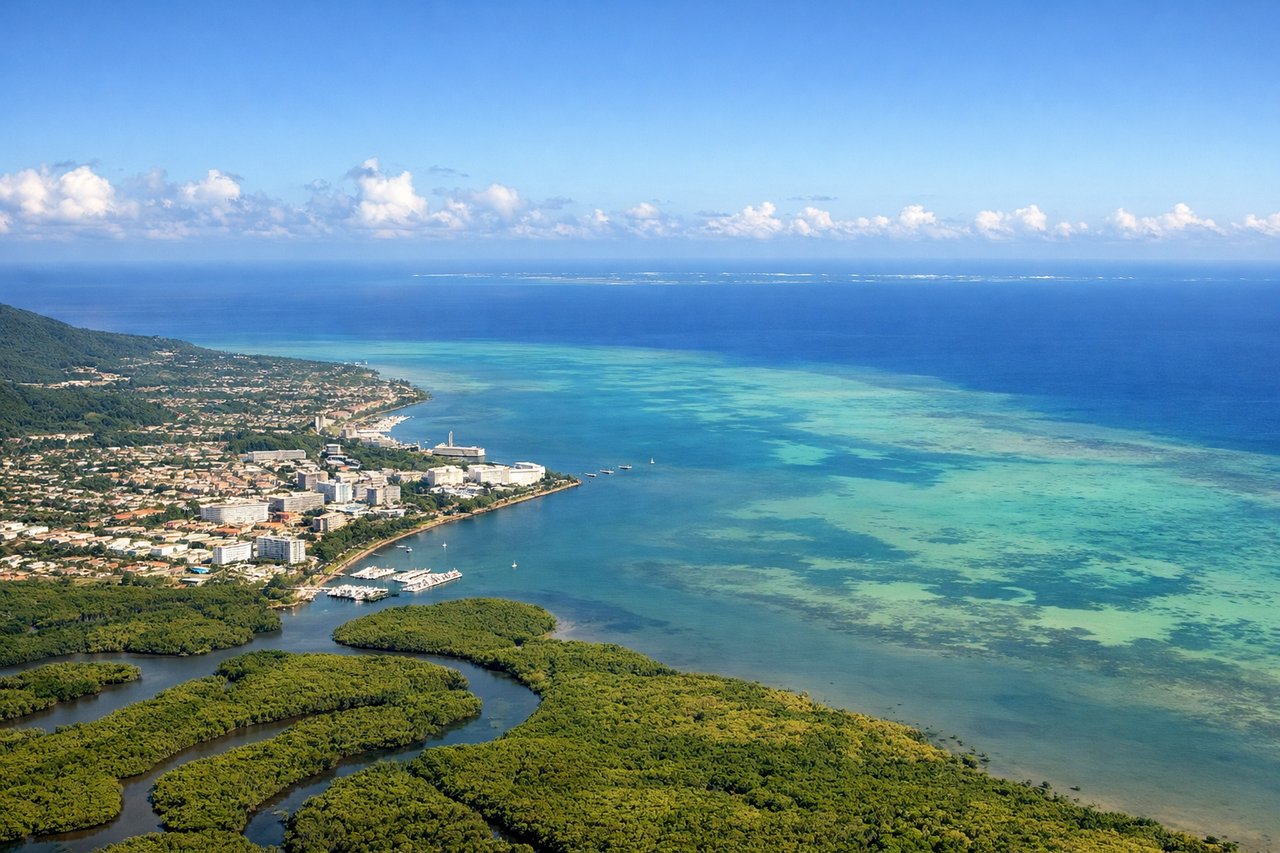
Takeoff from CNS
LEFTCairns typically departs northbound (runway 15) or southbound (runway 33). Left seats face west initially, offering views of the Great Dividing Range and the Atherton Tableland's elevated terrain. Right seats see only ocean and reef.

Landing at HKG
RIGHTApproaching Hong Kong typically uses runway 25L/25R (westerly approaches over Victoria Harbour). Right seats face north during descent, providing clear views of Kowloon Peninsula, Victoria Harbour's distinctive shape, and Hong Kong Island's northern waterfront.
Landmarks on this routeAll landmarks →
Will your flight be in sunlight?
See exactly which side of the plane gets sun and shade at your departure time.
About This Route
Which side of the plane should I sit on flying from Cairns International (CNS) to Hong Kong International (HKG)?
Sit on the Right side of the plane for the best views on flights from Cairns to Hong Kong. While takeoff favors left seats for mountain views, the landing approach over Victoria Harbour and Kowloon is more visually distinctive and memorable. Right seats capture Hong Kong's iconic urban-maritime geography during descent.
What can I see during takeoff from Cairns International in Cairns?
During takeoff from Cairns International (CNS), sit on the Left side for the best views. Cairns typically departs northbound (runway 15) or southbound (runway 33). Left seats face west initially, offering views of the Great Dividing Range and the Atherton Tableland's elevated terrain. Right seats see only ocean and reef. Notable sights include: Great Dividing Range (western escarpment), Atherton Tableland plateau, Barron River valley, Coral Sea to the east.
What can I see when landing at Hong Kong International in Hong Kong?
When landing at Hong Kong International (HKG), sit on the Right side for the best views. Approaching Hong Kong typically uses runway 25L/25R (westerly approaches over Victoria Harbour). Right seats face north during descent, providing clear views of Kowloon Peninsula, Victoria Harbour's distinctive shape, and Hong Kong Island's northern waterfront. Notable sights include: Victoria Harbour (iconic blue-water body), Kowloon Peninsula urban sprawl, Hong Kong Island's northern shore, New Territories hills to the north.
How long is the flight from Cairns to Hong Kong?
The flight from Cairns International (CNS) to Hong Kong International (HKG) takes Approximately 5 hours 45 minutes.
What does the Cairns to Hong Kong flight path pass over?
The flight path crosses the Coral Sea northwestward, passing east of the Great Barrier Reef (not visible at cruise altitude), then over the Sunda Strait region between Sumatra and Java. The Timor Sea and Arafura Sea are crossed at cruise altitude (typically 35,000 feet), where individual geographic features become indistinct. The South China Sea crossing offers minimal distinctive landmarks at altitude—mostly open water until approaching the Hong Kong approaches.